Cover photo courtesy of Lisa Laughlin
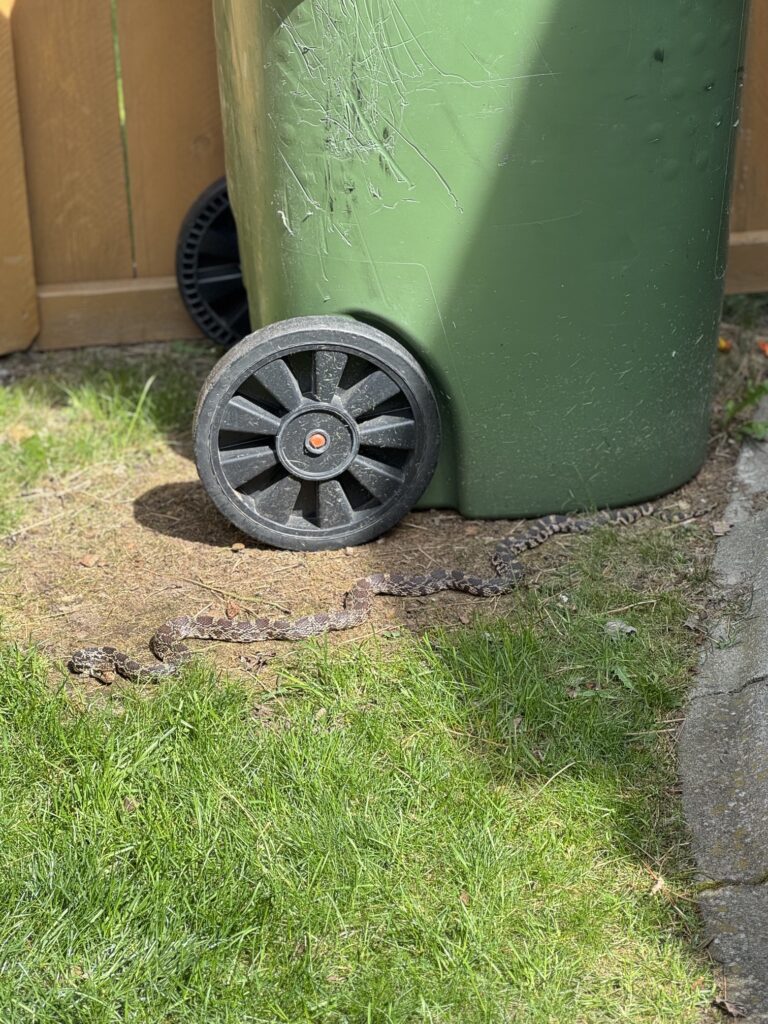
I stopped in my tracks before I registered why. I was carrying an armload of just-trimmed brush to my green bin, and there, stretched before it, was a 3-foot bull snake. I leapt. “Snake! Big snake!” I yelled toward my husband and dog and kids. But the snake didn’t move. I relaxed in kind and re-approached. I felt surprised, then, by two things: that it was there in my manicured suburban neighborhood, and that its brown and tan pattern had been evolutionarily (or culturally) wired to stand out to me, instantly, as a threat.
When I realized this bull snake had nothing more in mind than lounging near the cool green of my grass, I put my dog inside and invited my kids to admire it. We looked at it and it looked at us. Then it began to move like a silk scarf on a breeze. I climbed up on our cedar fence to watch it work its way underneath into the neighboring common area. I was enthralled. And made a note of how well it blended into the tawny browns and golds of native brush.
A few evenings later, there was a knock at my door. “There’s a snake,” my neighbor said. “We don’t know what to do.” I peered into the cul-de-sac to see her husband standing near it with a flat-nosed shovel. I walked out in my bare feet to join them. It was the same long snake from my yard.
I told them the snake hadn’t been aggressive. That bull snakes were known to eat mice. That I hoped this one would eat one of the squirrels that had been wrecking my garden. That made them laugh. And then a sort of magical thing happened. My neighbor with the shovel waved other neighbors driving home to slow down, go around. A teenager walking his dog came over to check it out, and stayed. We joked we should give the snake a name, if it was going to be a regular. Maybe Westwood. We watched until it crossed the last bit of asphalt and slipped under a juniper bush.
I didn’t see Westwood again after that night. But the encounter made me recall an earlier snake. Five years ago, my cat had brought a juvenile bull snake up to my back porch’s sliding glass doors. She batted at it and it batted at her. I had an 18-month-old toddler at the time, and I wasn’t thrilled about it. But after doing a thorough Google search on how to distinguish a baby bull snake from a baby rattlesnake (it’s all about the roundness of the tail), I picked up the baby bull with a reacher-grabber and placed it in a 5-gallon bucket. I listened as it hissed like sandpaper across wood. Then I tipped it out into the woods behind our home.
I couldn’t help but wonder if Westwood was the same juvenile snake, returned. My more practical side didn’t think a snake would remember a human’s kindness and come back to hang out. But it was true, wasn’t it, that our kindness mattered greatly? That our choices in how we treated wildlife today had ripples that might snake across the years? I could have picked up a shovel. Instead, I got curious. Both the snake, and I, were better for it.
I was inspired to share this story after editing Adam Gebauer’s nature column for this issue, “How to Love a Snake.” It’s a reminder that when we explore our public lands, the theme of this fall issue, we’re walking into the habitats of our fellow wild creatures. How we interact with them, and the land, has real effect. Take your curiosity, flip through the coming pages—with stories on the misunderstood lamprey, how orca art might inspire voting, the salvation of a moonlit hike and more—and come out the other side a bit better for it.
Lisa Laughlin, managing editor