By Jon Jonckers
Cover photo courtesy of Jon Jonckers
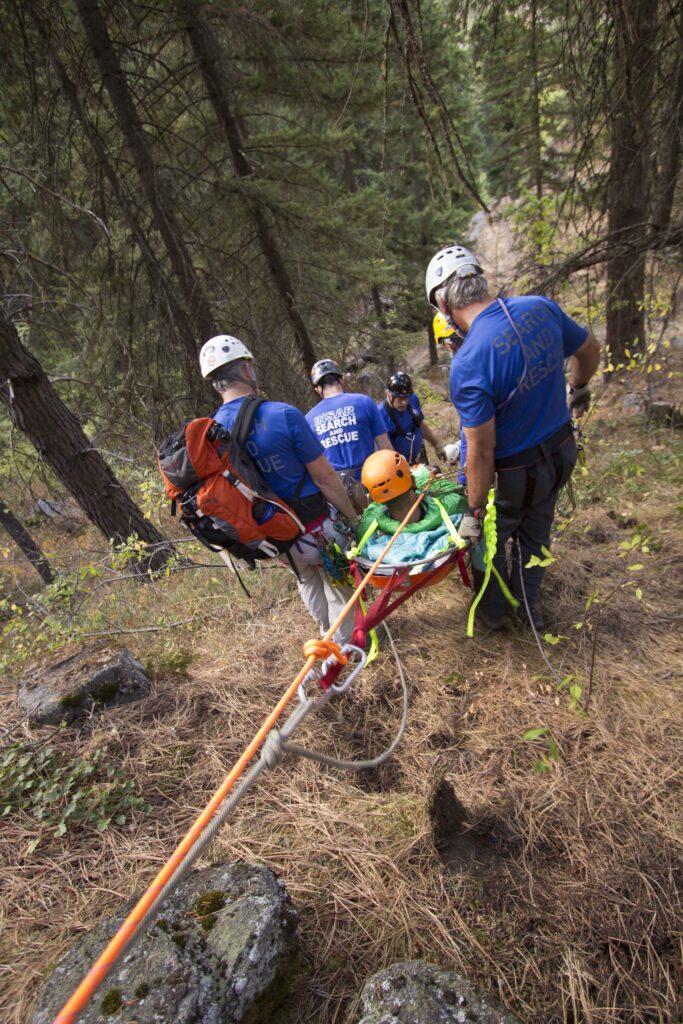
Search and Rescue (SAR) missions consistently rank among the worst activities that police, fire departments, ski patrols and SAR teams must conduct. At the heart of the matter lies the unknown variable: Will this be a rescue with a happy ending, or will they be recovering a body?
Deputy Philip Pfeifer is the Search and Rescue coordinator for the Spokane County Sheriff’s Office. His job whenever there is a SAR call is to coordinate with the public agencies alongside a dedicated group of trained volunteers. To prepare for the unforeseen backcountry incident, Pfeifer recommends every hiker bring some overnight gear even if there’s no chance they will need it. For example, always include a headlamp, fire starter, hat and gloves, especially at high elevations and in the cooler shoulder season months.
Equally important, here are four principles to consider every time you adventure into the wilds:
- Tell someone your full route, not just your destination. Often people who are found alive had told a specific person their exact path, including where they planned to turn around. Lost hikers who only said “going hiking” in a general location gave searchers 100 square miles to cover.
- Give a hard check-in time. Details like, “If you haven’t heard from me by 7 p.m., something’s wrong” can make all of the difference, starting a rescue search much earlier.
- Make sure your check-in person is reliable and knows how to respond. Lost hikers who survive frequently had a friend or family member who raised the alarm the moment the check-in time passed.
- Finally, make sure you can access your route somewhere outside of your phone for more reliable navigation. Service can be sketchy, batteries die, devices get damaged when dropped or submerged, and electronics can and do go haywire. Bring a map, learn how to use a compass or bring along a guidebook.
Pfeifer suggested downloading and learning to use one of many apps that can provide some peace of mind for family when used properly, such as the Life360 app. It has a lot of safety features, along with crash detection, which makes it a popular choice. He also noted that it’s a bad idea to try new gear for the first time on a big trip. In other words, bring your old Garmin watch that you know how to use along with your new Garmin watch just in case you don’t have everything set up correctly or it isn’t working right on your first outing.
Recco technology increasingly proves useful during search and rescues too, especially in the winter months. Recco reflectors return a signal to searchers with a detector. This detected signal will lead right to your location. Recco reflectors don’t require batteries or power, they’re very affordable and they’re very accurate.
For anyone interested in the nuts and bolts of search and rescue, Pfeifer recommends “Lost Person Behavior” by Robert Koester. This foundational book took a field that historically ran on tribal knowledge and gave it a statistical backbone. Published in 2008, Koester compiled and statistically analyzed thousands of actual SAR case records. Instead of one-size-fits-all advice, it breaks lost people into categories—hikers, hunters, children by age group, people with dementia, despondent/suicidal subjects, mountain bikers, etc. Then it gives concrete and actionable numbers. No joke, this book isn’t just for SAR—it also gets referenced by wilderness EMS folks, park rangers and even in some outdoor education and survival programs.
Above all, Pfeifer says, know your limits. Always keep your mind on the big picture, and don’t be afraid to turn around. Those who don’t need a rescue or recovery can always come back to that location later.
Jon Jonckers has been a constant Out There contributor since 2006, and he still enjoys sharing his love for the region with readers.