But What’s Your Definition of Madness?
Cover Photo courtesy of Michelle Witthaus, Unleashed Marketing and Design
By Barry Campbell
Did Native American fathers and sons argue over their paddle-stroke cadence as they navigated the Lochsa River?
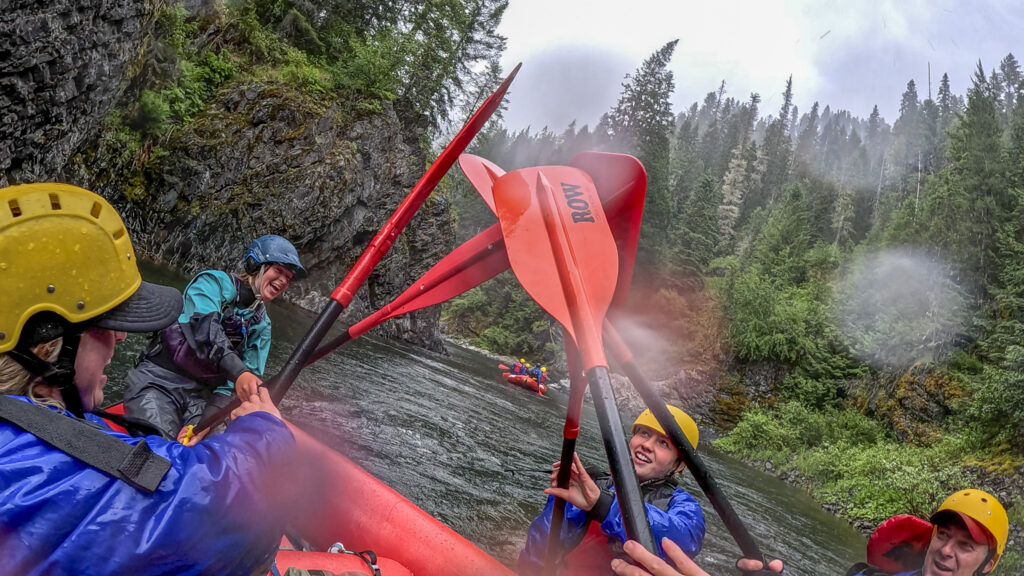
I uttered this thought aloud about halfway into our 20-mile trip with ROW Adventures, drawing solid laughter from our four raftmates and guide, and the consensus was yes. My 17-year-old son and I eventually rediscovered our rhythm—and occasionally lost it again when smacked by a huge swell—then regained it.
We’d volunteered for the front-row seats, the accompanying drenching and responsibility for setting the paddling pace. We offered to switch with our tripmates at our delicious lunch break, but there were no takers.
Thinking back to the original inhabitants of this area, I wondered: How could anyone canoe that river with any substantial flow? The Lochsa, which means “rough water” in the Nez Perce (Nimíipuu) language, Nimipuutímt, drops nearly 2,000 feet over 64 miles.
The Nez Perce were, and are, an advanced society with longstanding traditions of governance, art, trade, ceremony and a deep connection to the land. My son and I had both been enjoying learning more about their culture after experiencing a presentation from a Nez Perce elder about the significance of the Salmon River to the Tribe on a rafting trip a couple of years earlier. We’d had the privilege of experiencing the Middle Fork of the Salmon River at high flow in July 2022. We looked forward to experiencing another river historically paddled by the tribe.
ESCAPING ORGANIZED SPORT CAPTIVITY
The Lochsa is one of the nation’s most renowned rafting and kayaking destinations—located in the mountains of north-central Idaho, it’s only a 3.5-hour drive from Spokane. Rafting it hit our radar in 2022 on our first-ever rafting trip, when our Middle Fork guides said if we liked that trip, we’d love the Lochsa at high flow. It wasn’t an option until 2025 because the young man was playing highly competitive baseball every May and June, but he hung up the cleats in late 2024. When this trip presented itself, we were 100% in.
There are so many small-window spring outdoor activities in the Inland Northwest, and while it was hard seeing him leave a game he truly excelled at, going on a trip like this was a definite silver lining. It made me think about other families missing experiences like this in pursuit of the organized-sport prize.
PORTABLE TRAFFIC SIGN–WORTHY WHITEWATER
At high-water flows in May and into early June, the Lochsa draws thousands of boaters—enough to justify those large portable traffic warning signs along U.S. Route 12, which largely parallels the river. We were paddling on the Sunday of Memorial Day weekend, aka Lochsa Madness, but the river didn’t feel remotely crowded. And we were in great hands with ROW, which fed us well and strove to meet every need and request.
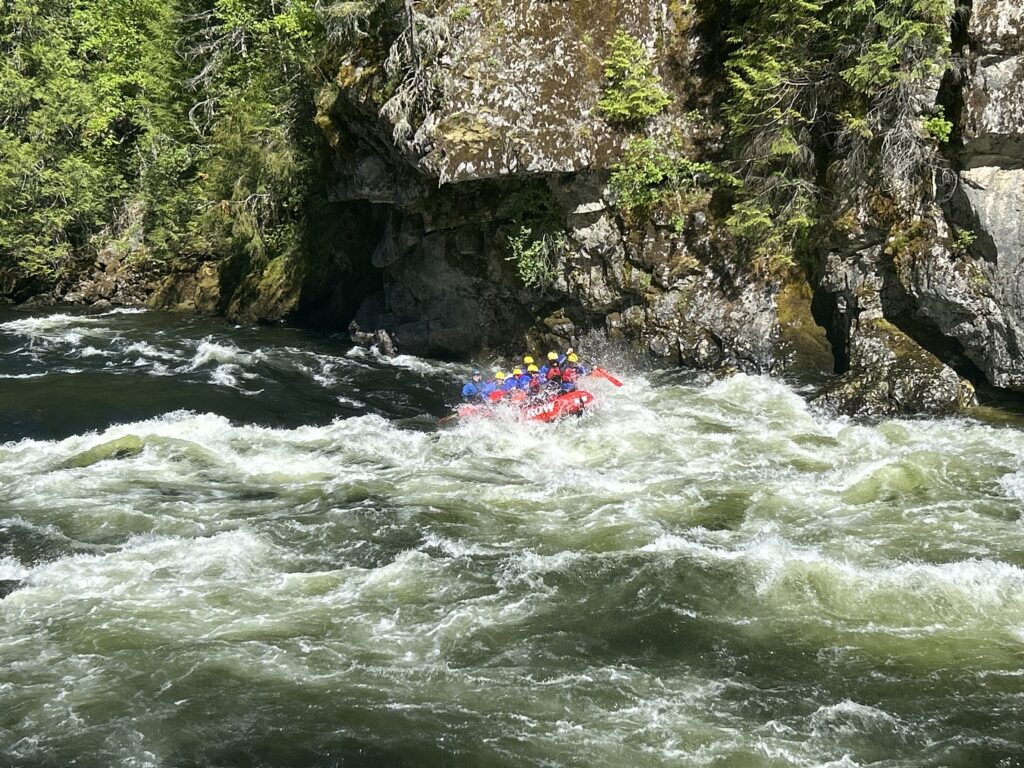
Lochsa Madness is an unofficial party festival where boaters do laps on the river and spectators line high-intensity rapids hoping to witness epic runs and fails. Shortly after passing a riverside disco ball (yeah, that’s normal), we were relieved to disappoint those cheering and jeering the boaters at Lochsa Falls by not dumping—and not searching for lost paddles or swimmers in the subsequent rapid called Picking Up the Pieces.
Farther down the river, we entered the Black Canyon, so named because the walls containing the river sharply constrict. In 1908, according to Bud Moore’s comprehensive book, “The Lochsa Story,” competing railroad companies sought to establish a track route from the Lolo Valley to Lewiston.
In the Black Canyon, representatives of one of the companies attempted to get their construction camp provisions in by boat. Ten or 12 men towed a boat from shore while one man attempted to keep it out in the current with a long pole. They failed, and the boat sank. No duh.
Of more recent river navigation, Moore wrote: “Rafters and kayakers delight in the same rapids that in 1893 wrecked the wooden rafts of the Carlin party, forcing them to leave George Colgate to die on a beach while the rest escaped on foot from the Lochsa’s mountains.”
PICKING UP THE PIECES
It’s a testament to our country and society that we’ve managed to keep that river flowing and the surrounding land healthy enough to support a tourism engine drawing thousands of tourists from all over the world who spend millions of dollars annually in the area. On the other hand, it’s an irrefutable travesty that in the span of roughly four generations we nearly erased an entire race of people and their culture from their once pristine and roadless land.
In an extreme example of this, consider: In the 1950s, the U.S. Forest Service sprayed the entire Lochsa Valley with DDT, attempting to rescue timber from spruce budworms. Moore, who was then ranger in charge of the area, was deeply involved in the decision. He later observed that before Europeans arrived, there were no “good bugs” or “bad bugs.” For thousands of years, insects had increased in the Lochsa’s forests when conditions were favorable, then ran their course and died out. “No force dominated for long,” Moore wrote. “Rather, all forces of nature harmonized, adjusting over centuries of time. But nature’s way seemed too slow and wasteful to us.”
In his seminal yet seemingly semi-forgotten book (several people I spoke with for this article, including some who are deeply knowledgeable about the area’s history, didn’t know of it), Moore wrote that “…we of the Lochsa, of the Clearwater, and perhaps as a nation have become willing victims of political, industrial and technological expansion of the same Manifest Destiny that shouldered the Indians out of the way of European domination of the West…We have become a divided people with respect to the use of the public commons. Yet we—the government and the people together—brought ourselves to this situation. And we should hold much closer together to work our way out of it.”
Those words, committed to print three decades ago, ring truer than ever. And one way of “holding closer together” is certainly careening down that awe-inspiring drainage with old and new friends. My son and I had a fantastic, epic day on the river—within a week, we signed on to raft the St. Joe River with ROW Adventures the following month. We’ll likely expand our Lochsa experience by doing the whole river, known as the “dirty thirty,” for this year’s river trip.
Overwhelmed by the gratitude of experiencing yet another in a string of fortunate “lifetime memories” with my only son, I still ruminated on the land surrounding the adventure and its human past and future. Getting blasted by waves that approximate a linebacker’s tackle doesn’t lend itself—in the moment—to getting deep and philosophical, but getting out in nature can have that effect, and for that I’m profoundly grateful.
Barry Campbell is an avid skier who runs his own marketing business, Two Oaks Marketing, to help fund his outdoor adventures. He lives in Sandpoint with his wife, son and golden doodle and is stoked whenever his daughter visits from NYC to enjoy Western adventures. He spends as much time as possible relaxing on Lake Pend Oreille, skiing steeps or biking singletrack and has developed a hankering for at least one annual whitewater rafting trip. He wrote the story “Ski Flakes” in the winter issue of Out There.