Three days of gravel roads, lava tubes and summit climbs in one of Washington’s wildest forests.
By Eric Deady
Cover photo courtesy of Eric Deady
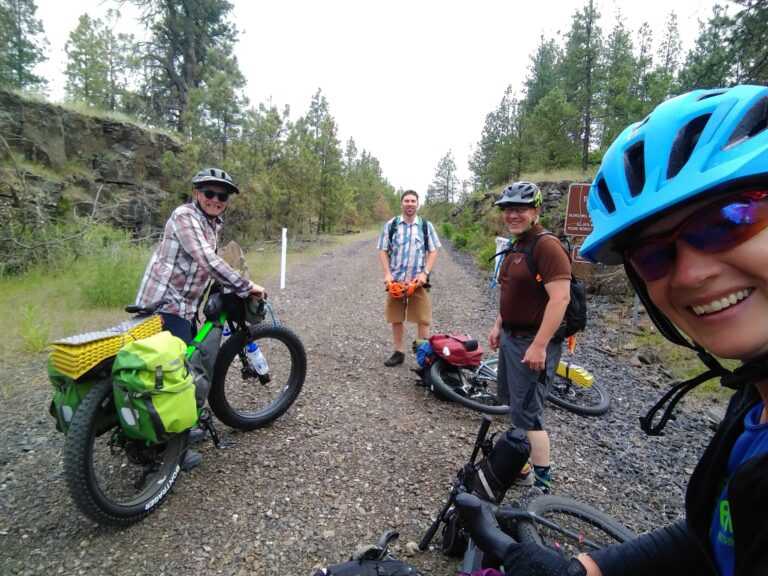
This past October, my friends Paula Funatake and Sarah Gates met me in Carson, Wash., for a bikepacking trip into the Gifford Pinchot National Forest where we would spend three days worshiping at the Church of Bike. Paula and Sarah are two of the most seasoned and respected cyclists in the world, and I was immediately comfortable riding with them. We launched off from the small town, intent on a three-day loop that would bring us deep into the heart of the Gifford Pinchot and its majestic mountain views of Mount Adams, St. Helens and Rainier.
The first several hours of riding brought us through town and into the woods in the golden, opaque light so common to the PNW in autumn. We started climbing the first of many mountains of the trip on pavement, but soon enough we found ourselves drifting along on the sublime gravel roads that the Gifford is known for, tires crunching along happily, and bikes now let loose onto the playground for which they were built.
Sarah is a force to behold on a bike. She is efficient, fast, and motivated in a way that only thousands of miles of riding can instill in a person. It’s truly a joy to ride with people who are in their element on a bike, and Sarah is one of those people who seem to have an almost effortless way about them. Her cycling resume includes a completion of the Great Divide Mountain Bike Route.
Paula is not concerned with speed, but is instead motivated by an internal desire to overcome any obstacle put in front of her, making her the solid foundation of any trip. Her perseverance is only eclipsed by her unmatched skill on the bike and inspirational attention to detail and trip planning. Paula is the person to turn to when a zipper blows out, a fire needs to be lit, or a trailside repair needs to be made.
A trio of riders rarely travels at similar speeds, and as the miles ticked away, the distance between us grew until we were each alone with our thoughts, with nothing but the sound of our breath and the crunching of gravel beneath our tires. It was a truly breathtaking area to travel through, made all the more magical by the vibrancy of the clear autumn skies.
Finding that First Summit Rhythm
By noon on the first day, we were at the summit of our first climb. Cresting the first summit of a bike trip is always a noteworthy experience for me. The jitters and nerves of trip-planning gives way to an overpowering sense of accomplishment. My body has been coaxed out of its normal idle, and has been flogged up the first hill, often at the expense of my dignity, with ragged breath and pouring sweat being the norm. But just like oil for the Tin Man, the first mountain lubricates the squeaky parts, freeing my body and settling me into a satisfying groove, as familiar and comforting as climbing into bed on a cold winter night. My legs and lungs have delivered me home again.
For me, one of the most surprising, yet crucial aspects of long-distance cycling is the meditative state that my mind and body are able to find while climbing mountains on a bike. The rhythm of pedals, legs, and breath fills a hole in my brain that is usually empty, or filled with the garbage and clutter of my everyday life. It’s as if every pedal stroke squeezes more and more toxic sludge from my mind, and replaces it with purpose, contentment and happiness. Smiles come easier, wounds become less painful, and the often-dark life that only hours before was filled with stress, worry, and sometimes sadness, transforms in the thin mountain air almost instantly into clarity, brightness, and light.
The day continued, with the dazzling fall colors of maples, alders and cottonwoods lighting our way up and down the mountainous terrain. We eventually crested one of many mountains and found ourselves in a small valley, framed on all sides with a deep green conifer forest and dotted with the small lakes and ponds so intricately formed by the beavers who called this valley home.
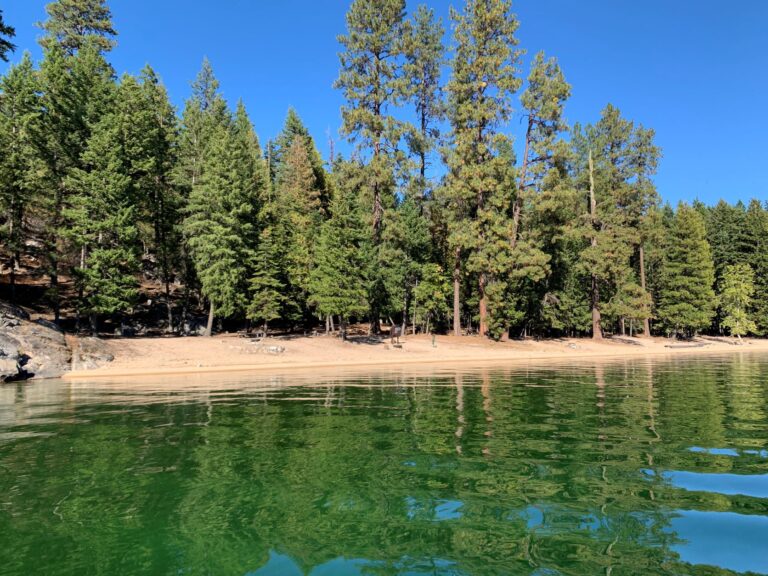
It’s easy to get overwhelmed by the beauty of such a place, but we knew there were more miles to travel before we could stop for the day, so we saddled up and continued our climb, content to let the miles slip by in our meditative way. Eventually, around dusk, we came to a campground next to an alpine lake surrounded by mountains and ringed with colorful trees intent on giving us a show.
This was a true blessing for a group of bikepackers who are used to sleeping wherever they can, often in a bush or a ditch. A campground has cleared ground, established sites, and, most importantly, picnic tables to sit down and rest your legs without needing to sit in the dirt. A rare treat! Day one passed in the blink of an eye, and all of the sore muscles, aching legs, and heavy breath were forgotten in the familiar routine of food preparation, tent pitching, wood gathering and storytelling. With our camp chores complete, sleep came easy, with Paula’s fire crackling faintly in the distance and the blackness of the forest night surrounding us like a warm blanket.
Pedaling into Lava Country
Day two arrived, and I was quickly reminded that day two is often the most difficult, and that bikepacking follows a very familiar pattern for me: Day one is hard because your body is adjusting to the effort and time in the saddle. Day two is harder, because the adrenaline has worn off and been replaced with sore muscles and the prospect of more miles ahead. Day three is always a little easier than day two, because your body is adjusting to the routine, and has finally agreed to cooperate. Day four is always “Superhero Day,” when you have adjusted to the routine, your legs have switched on, and you feel like you could ride forever.
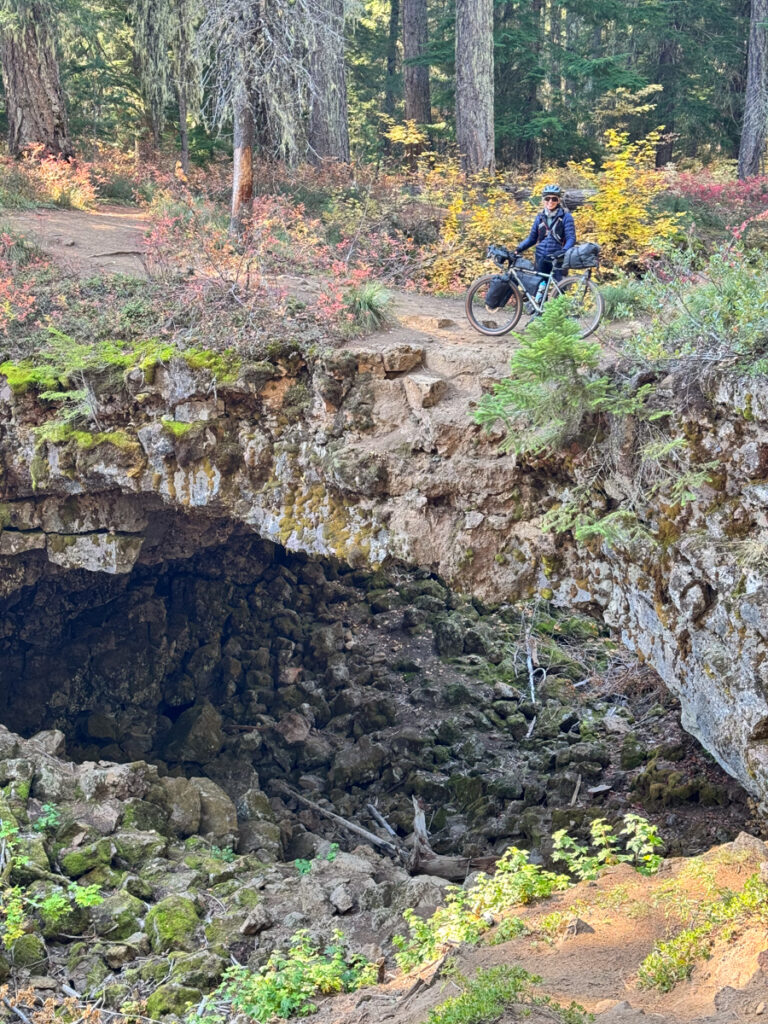
On day two, we were greeted by a clear and still sunrise over the lake and quickly packed up camp and began the day’s effort. Our goal was to find one of the lava caves that are prevalent in the area, and by mid-morning, with Sarah’s help, we had found a spectacular natural bridge formed by a collapsed lava tube where we spent some time taking photos and simply staring at the spectacle in front of us in disbelief. Not long after, we came across a fully-formed lava tube and descended into it with headlamps at the ready. Seeing a jumble of rocks in a pile on the floor of the cave did not inspire confidence about the structure, however, so we carefully backed out of the cave, thankful to have not been crushed by falling stone.
The rest of the day was full of long climbs. The jagged shape of Mount Adams appeared to our east, still capped by snow despite being so late in the season. We could see forever, and felt truly fortunate to be there during such spectacular weather. The riding that day would bring us to the high point of the route, and then we would trend downhill for the next day and a half.
The hard part was behind us, and I entered into a much more relaxed frame of mind, knowing that the bulk of the effort was complete, with undulating miles of gravel roads spooling out in front of us for the rest of the day. Eventually a decision was made to deviate from our original route and attempt to get through a washed-out section of road that had seen very little use. This was the type of riding that excites me, with some bushwhacking, pushing, and scrambling through areas that are only accessible to those foolish enough to attempt them. The scramble through the washout offered all of those things, so we decided to stop for the night before we made the attempt.
Around dusk, we found a nice flat spot just off the trail and quickly got to work making camp in a routine that has become familiar and comforting over the years. Unload the bike into organized piles of sleep kit, kitchen, hygiene, and clothing. Then pitch the tent, air up the sleeping pad and pillow, and lay out the sleeping bag. Strap on the headlamp, and get to cooking and heating water, while half-heartedly looking for firewood for the night. Change clothes, eat dinner, wash up, tell some lies, and it’s off to sleep, usually very well because of the effort of the day.
The Final Descent
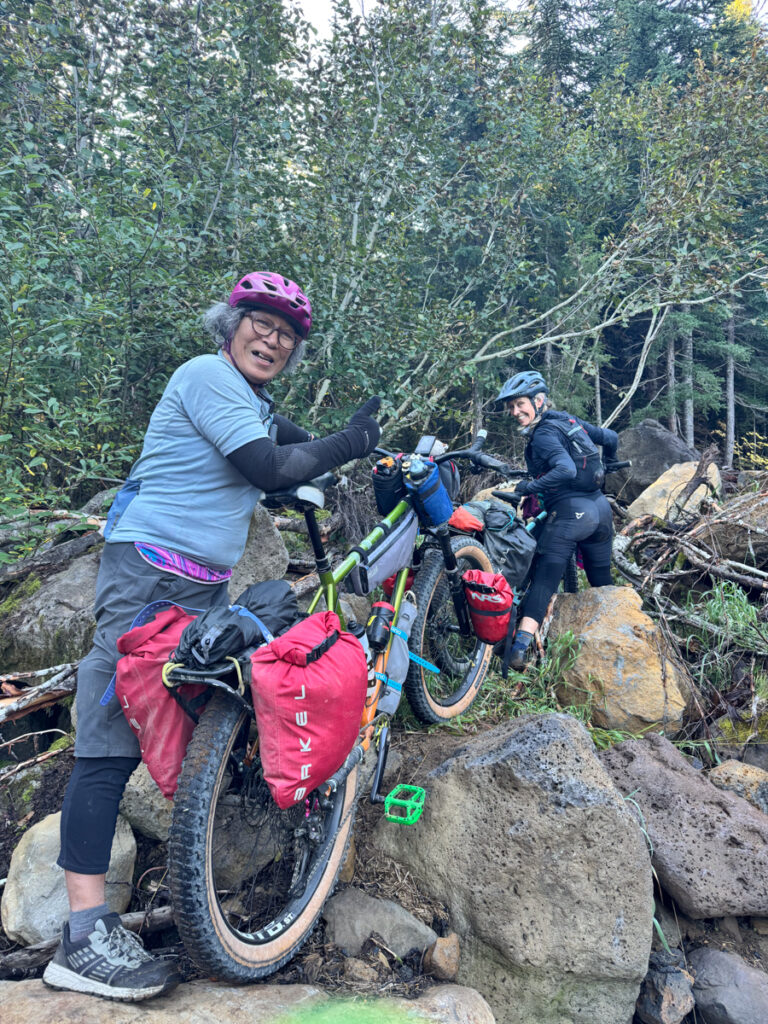
Day three started with a short warm-up ride up to the beginning of the washout section, where we expected to find some challenges. We were a good team though, and made short work of the section by helping each other push and heave our bikes and gear through the creek, over the boulders, up the muddy far side of the wash, and through the overgrown mess of fallen trees and thick brush to where we could pick up the trail again.
We found ourselves at the far side of the washout covered in mud, scratches, and bruises, but happy to have made it through and be back on the trail. Dragging a loaded bike through a section of terrain like that is always a lesson in patience and perseverance, with each obstacle presenting its own puzzle to solve. I have learned to appreciate, and even look forward to, this type of thing. It means that adventure is happening, and memories are being formed.
Shortly after the washout, the trail improved enough to be rideable again, and we pedaled contentedly for the next few hours, happily watching the scenery passing by and savoring the moment, knowing that this would be the last day. All of the climbing that had taken us a full day and a half to complete now lay ahead in the form of an insanely fast descent all the way back down the mountain to the valley below. It was a true “white-knuckle” descent of almost 20 miles, and I had to stop periodically to cool down my brakes and give my hands and shoulders a rest from gripping the bars so hard. The descent was smooth, fast, and curvy, and we were all grins and laughter by the time we reached the valley floor, knowing that the last of the challenge was now behind us. We only had to pedal the last 15 miles of the route and we would be back in Carson where we began.
Short backcountry bike trips are food for the soul, and this one was just that. Despite our trip being only three days long, the Pacific Northwest has a way of making you feel like you belong and have been there forever.
Eric Deady spends his time in the Idaho Panhandle as a bike guide, bikepacker, and father. Baja California, Mexico is calling for him this fall, where he will tackle the Baja Divide again.