By Ammi Midstokke
People are always recommending science books and memoirs to me, which is a bit misguided because I like to consider myself a classics kind of reader. I believe having slogged my way through “Moby Dick” gives me bookish street cred. Recently, someone handed me a copy of Jason Roberts’ “Every Living Thing,” and I took it because there were flowers and a seven-headed dragon on the front.
It is the riveting tale of two naturalists in the 1700s and their passionate disagreements about how to name things. I have come to two observations. First, how strange it must have been when most knowledge had to align with biblical texts or you’d be burned at the stake. It seems it would be a bit of a dampener on curiosity. Also, what happened to all the savant kids who were mastering Latin by the age of seven?
These two naturalists differed in a few ways. One, Carl Linnaeus, a likely narcissist and a forefather of racism, created an arbitrary naming system based on the belief that all plants and animals were made in six days. Nothing evolved. Nothing went extinct. The other, Georges-Louis de Buffon, accidentally described evolution a century before Darwin and was highly suspicious that plants and animals and humans were all of a natural order we could not possibly understand through a man-made system of naming. And certainly not without better knowledge about the plants and animals themselves.
Linnaeus wanted to apply a system to nature. Buffon wanted nature to reveal its system.
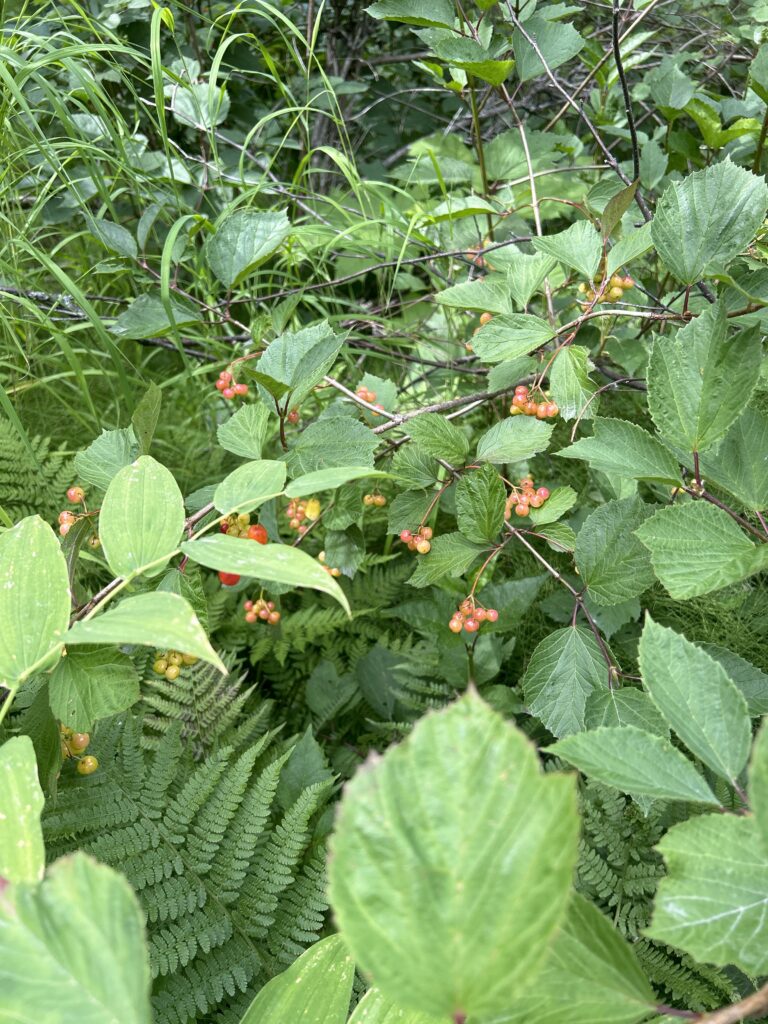
I did not expect a book about a Swede and a Frenchman threatening some botanist’s duel would change how I look at plants. I have applied generally antiquated assumptions to them, like divine instruction. If a plant has a heart-shaped leaf, it’s probably good for your heart. If it is shaped like a liver, it’s probably good for your liver. Before Linnaeus and Buffon, physicians were regularly poisoning patients with this method of identification. Sometimes, I employ reliable children’s rhymes: “Berries white, run in fright!” I don’t always run away, despite this sage advice. Mostly, I wander through the woods and give plants names I can remember, like “Orangey June Vine Blossom Thing.”
Their true name is Lonicera ciliosa, commonly known as honeysuckle. But which of these three names connects a person most to their experience of the plant?
The philosophical questions of how our reality is shaped through individual experience of nature, and how much of it is shaped through prior knowledge, have me wondering how much we lose by having only one or the other. If we only have experiential knowledge, we might eat the poisonous plant. If we only have prior knowledge, we might never know the delicate perfume of wild rose. Because both of those are still limited to the human lens, I can only imagine how much else we’re missing when it comes to understanding plants. How does the entangled elderberry know the honeysuckle?
Barring the consumption of an inordinate amount of psychedelic mushrooms while snuggling with nature, it is likely our limitations cannot be exceeded. However, recognizing how little experiential and prior knowledge we have about the nature in which we navigate suggests that our cohesive experience of it could be greatly improved by increasing both.
Which is simplified by Cicero as: Si hortum in bibliotheca habes, deerit nihil. “If you have a garden and a library, you will lack nothing.” Or as this writer might say: Take your botany book into the woods more often.
Ammi Midstokke is preparing to grow a garden this spring and planning to label her plants for once, perhaps even with their actual names.