By Karie Lee Knoke
Cover photo courtesy of Karie Lee Knoke
It’s my favorite time of year again! It’s time to head into the forests and meadows and see what’s popping up.
Foraging for bulbs and tubers feels a little like hunting buried treasure: you’re reading the land, following clues, and digging for something hidden and nourishing. Bulbs and tubers are the most satisfying foods to gather because of their high-carb profile. But it’s also one of the easiest places to make a serious mistake if you get sloppy. It’s a skill that asks you to stay sharp.
Spring is where it all begins. Snow pulls back, the ground softens and suddenly the forest floor starts waking up. Glacier lilies are often the first to show themselves. Bright yellow, delicate, crisp and refreshing, almost like a wild cucumber. They’re not big, but they’re a welcome taste of fresh food after a long winter. The whole plant is edible.
Then come the spring beauties—tiny, star-like flowers scattered across the ground. Their little corms are about the size of a pea but can grow up to the size of a gumball. You’ll have to work a bit for them, but that’s part of the rhythm. You slow down, get close to the earth, and start noticing things you’d otherwise miss.
And then . . . meadow camas. If you’ve never seen a meadow in bloom with camas, it’s something you won’t forget. Blues and purples stretching across the landscape, and underneath? One of the most important traditional food sources in North America. When you cook camas low and slow, it turns sweet and rich, like nature’s version of caramelized onions.
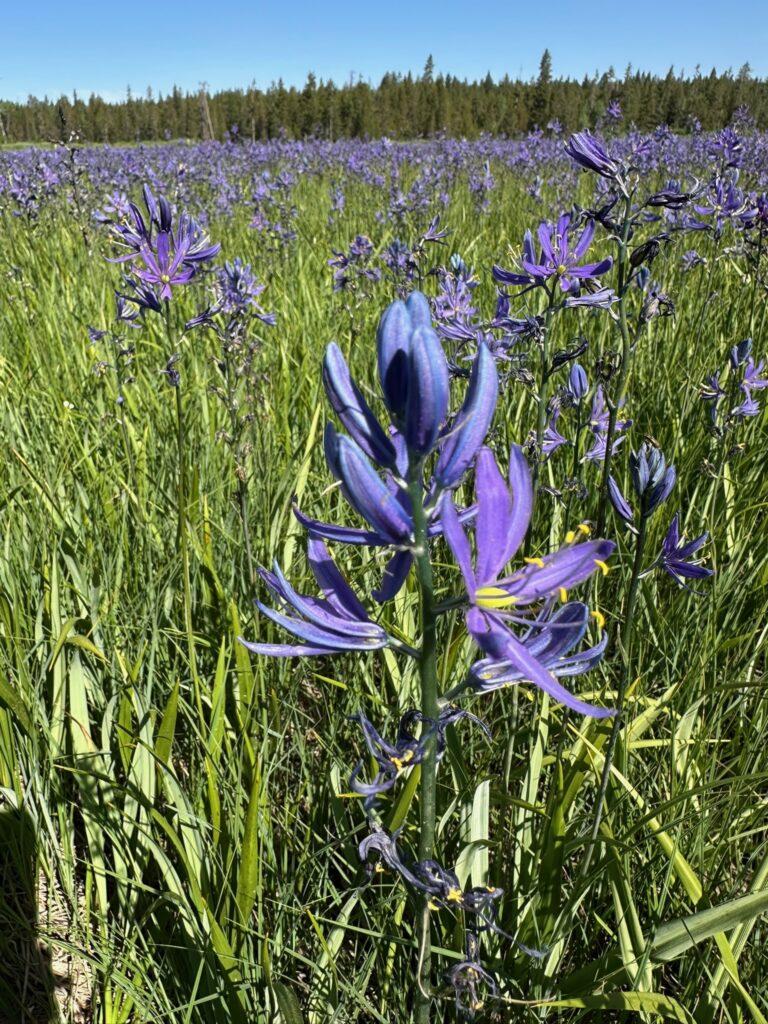
But here’s where the excitement needs to be grounded with awareness. Camas has a dangerous lookalike: death camas. Same general area. Same growing season. Entirely different outcome if you mix them up. Death camas usually has white or cream-colored flowers, but don’t hang your safety on color alone. You want to know what you’re looking at from top to bottom. Here’s the rule you don’t bend, not even once: If the bulb is not attached to the plant you identified, you do not eat it.
When you dig, you follow the stem all the way down and uncover the bulb while it’s still connected. No loose bulbs. No guessing. No “it was growing nearby so it’s probably fine.” That’s how people end up harvesting something like death camas by accident, and that’s not a mistake you walk away from easily.
Think of it like this: every plant has its anchor. If you lose that connection, you’ve lost your certainty.
Out in the drier hills, mariposa lilies (also known as sego lilies) show up with their beautiful, open flowers and solid little bulbs underground. These are worth digging when you find a good patch. Fritillaria, sometimes called chocolate lily, adds a bit of variety too, though it can be bitter if you don’t prepare it right. Not everything in the wild is instantly delicious, but that’s part of the adventure.
And if you really want to switch things up, head toward water. Wapato, also known as Indian potato, grows in muddy, shallow wetlands. Harvesting it is less “digging” and more stomping around in the muck until the tubers pop loose and float to the surface. It’s messy, it’s cold, and it’s surprisingly fun. Plus, wapato is packed with nutrients and makes an incredible wild staple.
Once you get the hang of it, though, this kind of foraging becomes wildly rewarding. You start to recognize patterns, see where plants like to grow, how they cluster, when they show up. It turns into a kind of conversation between you and the land.
Done right, foraging bulbs and tubers is equal parts adventure, skill-building, and deep satisfaction. It gets you dirty, wakes up your senses, and reminds you that some of the best food out there is hiding just beneath your feet. You will never walk through the forest the same way again!
Check out my Wild Foraging Pocket Guidebook to learn more about finding wild food.
Karie Lee Knoke is a wilderness and primitive skills instructor and founder of Sacred Cedars Wilderness School. She was a contestant on the reality survival TV show, “Alone Season 9,” on the History Channel. For more information, visit Karieleeknoke.com or follow her on Facebook @SacredCedarsWildernessSchool or Instagram @karie_lee_knoke.