By Rachel Toor
Cover photo courtesy of Rachel Toor
There are lots of weird niches in the world—extreme ironing, competitive tombstone rubbing—that are only weird until you discover one that appeals. I found mine three decades ago in the office of a Duke professor, where I saw photos of people riding horses while wearing running gear.
The professor asked, “Do you run?” Yes. “Do you ride?” I did, as a girl. “I have an Arabian gelding who’d like to meet you,” he said, and that was it. Ride and Tie became my sport.
In the early 1970s, when Levi’s wanted to sponsor an event, their PR guy read about a practice used when two people needed to cover ground with only one horse. Here’s how it works: Person A rides ahead, ties the horse to a tree, then runs. Person B runs to the horse, unties it, rides past Person A, ties the horse, then runs. They leapfrog for 20 to 50 miles. The professor described it as “the thinking athlete’s sport,” since much depends on strategy.
My first race was in 1996 with a partner I didn’t know on a mount I’d never ridden. Among 160 competitors, 80 amped-up Arabians and a whole slew of support crew, I found my niche.
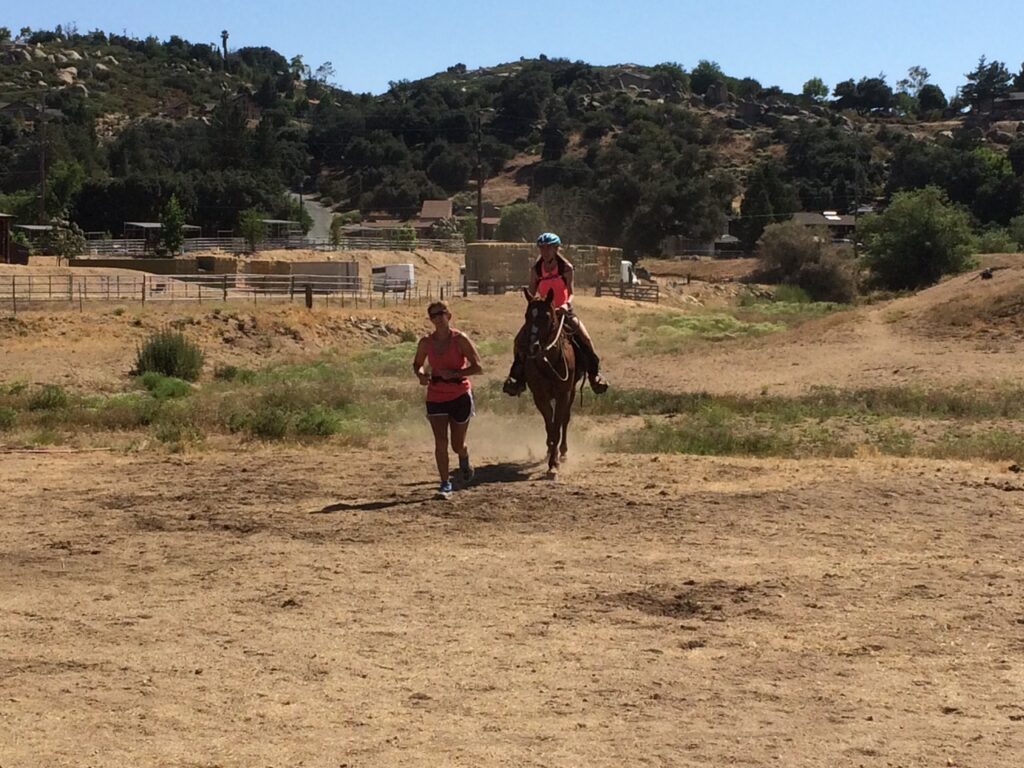
Without a horse of my own, I relied on others to choose me as a partner. A good age-group runner and an athletic, if unschooled, rider, my advantage was being light. Strategy involves exploiting each human’s strengths and keeping the horse healthy. On climbs, it takes less effort to carry me than a bigger man, while better equestrians ride downhill at speeds I find terrifying. For runners, it’s like doing mile-ish repeats, then resting in the saddle at a trot or canter. You must mount and dismount many times. There’s no whining.
While any well-conditioned horse could cover the distance, Arabians—endurance athletes—will run themselves to death, so vets at checkpoints ensure they are sound. One person rides into the check, leaves the horse with supporters and runs out. The crew cares for the horse so when the trailing human runs in, she shows the horse to the vets and gallops to overtake her partner. If the horse is “pulled” and you’re the teammate who has already run out, you get to finish on foot.
Things go wrong. If a horse spins around a tree or you’re too pooped to pay attention, both people can end up in front of the horse. You don’t get a completion buckle until everyone reaches the finish together. Horses lose shoes. A borrowed mount once refused to let my partner, a legendary runner, mount. One partner “couldn’t” run without headphones, so she didn’t hear people yelling, “Your horse is loose!” Another supercompetitive partner, as we were about to win the woman/woman division, handed the horse to me for a last “flying” exchange. She said, “I peed in the saddle,” which was covered with a sheepskin pad. I finished riding, standing in the stirrups.
It’s hard for herd animals to stay still while friends gallop past, but after what can be exciting first miles, most settle in. The horse, tied to a tree, watches his partner leave, then turns to wait for you. When he sees you, he nickers, raring to go once you hop on.
At the end of a long race, you’re thankful to your equally spent human partner. But the gratitude and connection you feel with the horse is like nothing in the world. People either think it’s nuts or ask where to sign up. If you want more info, check out rideandtie.org.
Rachel Toor is a professor of creative writing at Eastern Washington University and is a mentor for the Ride and Tie Association. Reach out to her there to hear more about this great sport, especially if you have a horse. (She misses riding.)