By Linea Jantz
Cover photo courtesy of Dave’y Lumley
I grew up in the high desert of Eastern Oregon, near the native waters of the Pacific lamprey. Yet I was an adult before I first heard of lamprey, mentioned in passing as a sort of demon parasitic eel that could climb a vertical rock face with its suction cup mouth bristling with teeth.
Last year, I brought my kids to the Kittitas Environmental Education Network’s annual community event Get Intimate with the Shrub-Steppe (GISS). As we meandered among educational booths, my boys noticed a table with a glass fish tank. Curious, we approached.
A big disc mouth suctioned onto the glass, looking like a halved passionfruit with fangs. Attached to the mouth was a muscular wriggling eel of a body. Delighted, I asked the woman behind the table what this strange creature was.
“That’s a Pacific lamprey.”
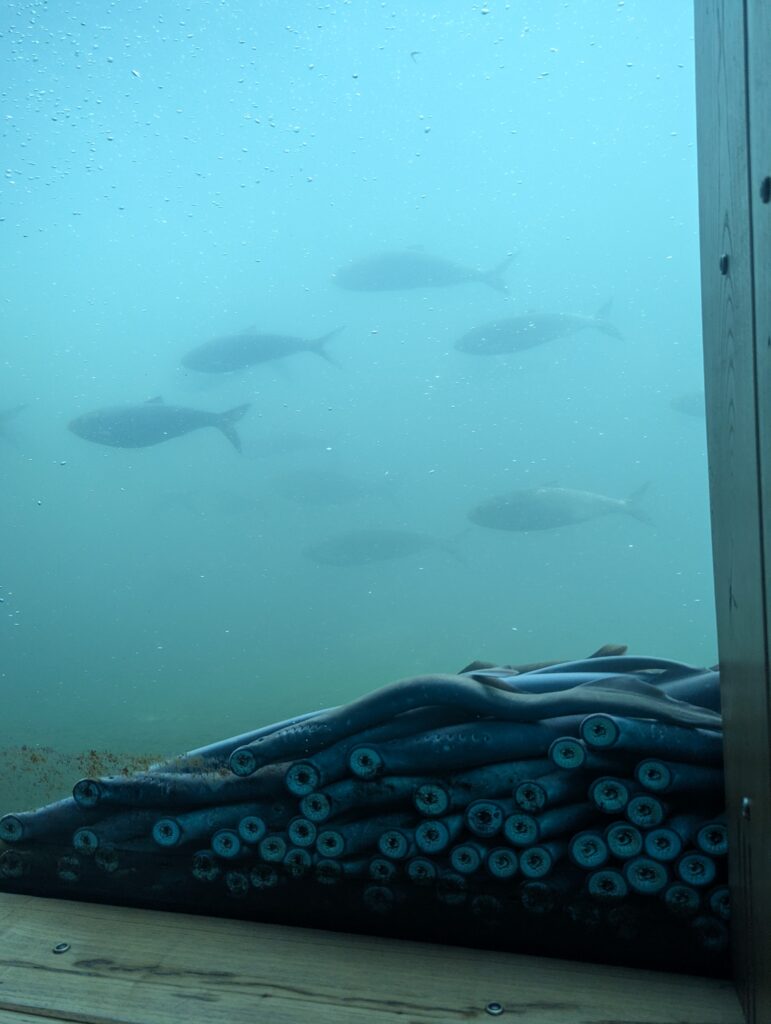
This shy fish was the scary “eel” that writhed over big waterfalls like Willamette? Patient staff from the Yakama Nation Fisheries answered our many questions and taught us interesting facts about the lamprey. Like how lamprey are some of the oldest fish on earth, part of a class of jawless fish called Agnatha that evolved over 450 million years ago. They have been swimming in our waters since before dinosaurs roamed and even before trees existed. They have a third eye on top of their head that senses light or darkness. They don’t have bones; they have cartilage like a shark. They breathe through seven gill pouches on each side of their head.
Our interest in lamprey piqued, the boys and I embarked on an adventure to learn more. We watched “The Lost Fish – The Struggle to Save Pacific Lamprey,” a film collaboration between the Columbia River Inter-Tribal Fish Commission, the U.S. Fish and Wildlife Service and Freshwaters Illustrated. We learned that in the late 1960s and early ’70s, lamprey were considered a trash fish, perhaps a danger to more desirable fish like trout and salmon. A state industrial fishing program poisoned the Umatilla River a couple hours north of my hometown. Elders of area tribes reported that thousands of lamprey washed up dead along the riverbank as a result. How had I never heard of this?
For a deeper dive, this June, the boys and I drove to Oregon City for the Willamette Falls Lamprey Celebration, hosted by the Yakama Nation. Over 1,000 people gathered for a day of learning about lamprey and Columbia River health, dancing, traditional songs, speeches, free boat rides to Willamette Falls and a salmon bake, which included a piece of barbecued lamprey for each person to taste. I would liken the flavor to a chewy mix between eel and turkey giblets.
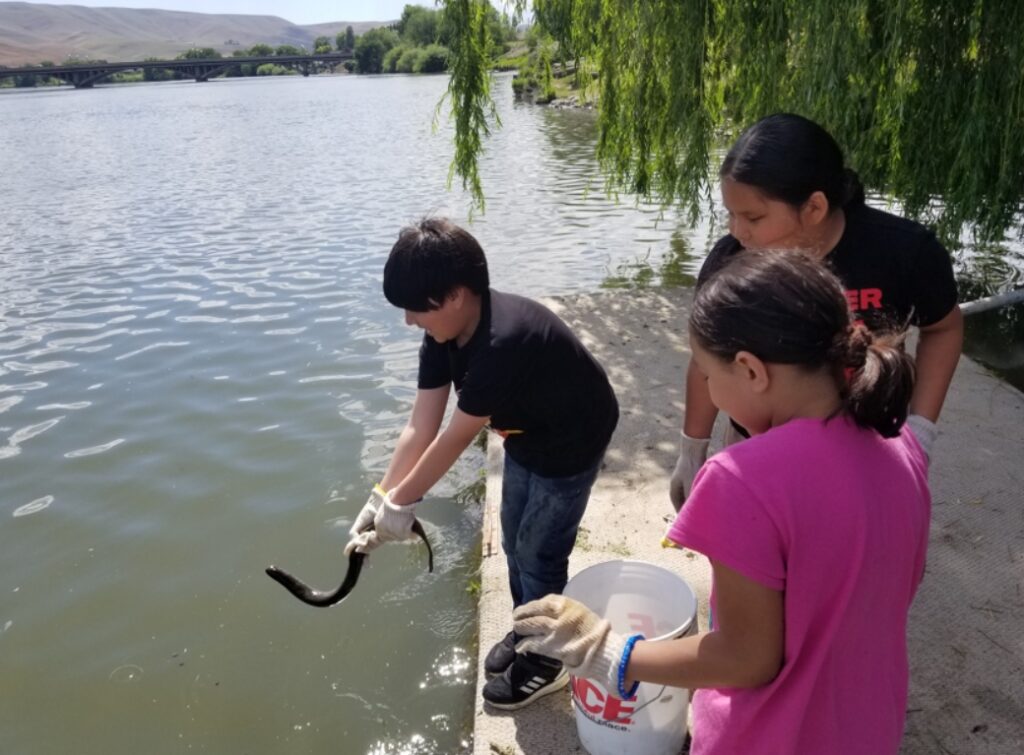
Before dams blocked passage on the Columbia River, millions of lamprey used to return each year, making for an abundant tribal harvest. Conversely, in 2011 only 48,000 returned to Bonneville Dam. Lamprey aren’t strong enough swimmers to jump up fish ladders like salmon. Engineers are working to redesign fish ladders at dams to improve lamprey passage, but progress is slow. As a stopgap measure, biologists truck containers of lamprey around the dams to release them into their ancestral rivers.
Biologist Dave’y Lumley started working on the Yakama Nation Fisheries’ Pacific Lamprey Recovery Project in 2011. She started in the field as a tech, salvaging young lamprey from dewatering irrigation ditches with the support of landowners and irrigation districts. Over 15 years, she has learned a lot about these fish. “Lamprey are ecological engineers,” she told me. At each stage of their life cycle, they contribute to their ecosystem and other fish.
Female lamprey lay over 100,000 eggs, some of which are eaten by rainbow trout and dace. The young lamprey larvae and ammocoetes live in fine sandy substrate for 4 to 7 years. They act like earthworms, aerating and feeding on organic matter in the stream bottom.
As they transform to juveniles, the lamprey develop eyes and suction mouths and become silvery. They may travel up to 620 miles to reach the ocean. As lamprey are slow swimmers and rich in desirable fats and nutrition, they provide a buffer for migrating salmon from predators like seals, eagles and other fish.
Lamprey live in the ocean for 2 to 3 years, swimming in deep waters and periodically attaching to a host fish for a blood and fluid snack before dropping off. Once they begin their freshwater migration, lamprey stop their parasitic behavior. They don’t eat.
Between May and July, lamprey follow the pheromones and scents of younger lamprey to streams where they can spawn. Both males and females use their sucking mouths to move rocks to form a redd (egg nest). After spawning, lamprey die, bringing rich marine nutrients to the stream plants and animals.
In addition to being a vital part of our waterways, the lamprey is deeply important to Pacific Northwest Native peoples. This fish is considered an elder, a first food, a friend from the cradle to the grave.
How can the general public help lamprey? “Most importantly, they can just be open to hearing about them,” Lumley said. Outreach efforts have greatly expanded in the past couple years, getting the word out that these fish are not a danger to humans or fish in our rivers.
Leavenworth Fisheries Complex Park Ranger Sophia Troeh suggests further: Promote clean water and reduce pollutants. Support lamprey-friendly fish passage. Avoid major disturbances to streambeds during spawning season, especially with heavy equipment. “Elmer Crow’s words in ‘The Lost Fish’ film resonated deeply with me, she says: “How do we let something that’s 450, 500 million years old go extinct? Shame on us—the whole bunch of us—for not paying attention to what was going on. We can’t go back in time, but we have the power to shape a better future for Pacific lamprey (and ultimately ourselves) by taking action now.”
Linea Jantz is an avid mountain biker and flatwater kayaker. This fall you can find her frantically soaking up as much sunshine as possible before the dark months hit.