Imagery, advocacy and Save Our Wild Salmon’s fight for the ballot box
By Linea Jantz
Cover photo courtesy of Ramon Shiloh
Save Our Wild Salmon (SOS) is a coalition of conservation organizations, recreational and commercial fishing associations, clean energy and orca advocates, businesses and individuals. All of these varied groups have banded together with the shared goal of restoring healthy and abundant salmon and steelhead in the Columbia-Snake River Basin for benefits to ecosystems and communities across the Northwest—including the Southern Resident Orcas.
A unique SOS project, the Northwest Artists Against Extinction (NWAAE), began from a conversation between SOS executive director Joseph Bogaard and Vashon Island artist Britt Freda. Bogaard told Freda that in the many years SOS had been advocating for salmon, they had gathered lots of data. They had great science and research. But he wondered . . . What actually moves people? What would change people’s patterns and hearts? He asked Freda what she thought about bringing art into the policy and advocacy conversation. In 2022, Freda hit the ground running as NWAAE’s creative director.
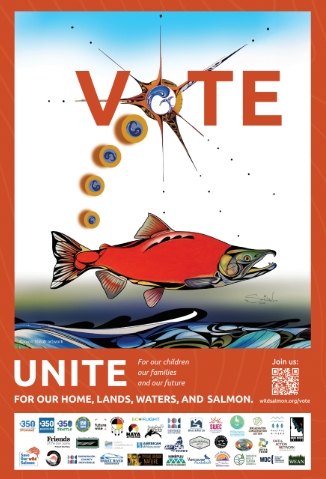
Since then, NWAAE has partnered with 35 organizations across the region to distribute artistic materials throughout the Pacific Northwest to encourage and inspire people to unite and to VOTE. Posters, voter resource cards and other materials feature art from Ramon Shiloh, Kat Martin, Oonaugh Foster-Bill, Aiden Pando and Lynn McClain.
SOS policy and advocacy director Tanya Riordan shares, “Who we elect to office has profound impacts on us, our families, our neighbors and our community [. . . ] yet, according to Pew Research Center, the past two midterms in the United States saw fewer than 50% of eligible voters participate. Voting is the heart of our democracy, and yet, these recent numbers show that we are not engaging and inspiring the majority of people to exercise that right. So we wanted to use art, creativity, joy and a unifying message to do our part to change this dynamic.”
I asked Freda how art can serve as a tool for advocating for the salmon. “People of all sorts of different persuasions value the outdoors,” she says. “Art has the ability to bridge the gap between groups because it doesn’t revolve around certain language from one camp or one ideology. It is memorable. It makes us feel. It gives us common ground. Art doesn’t tell us what to think. It asks an open-ended question.”
Inadvertently, I saw firsthand the impact of art for advocacy. One of the posters for this Get Out the Vote campaign features a single salmon above three fading orcas. In the waters below, skeletons of whales and salmon float, mouths open in a silent cry. It reminded me of a painting I saw years ago of one salmon alone and surrounded by every surviving member of the Southern Resident Orcas. I remembered what a gut punch it had been realizing that there were so few of these orcas left they could all fit in that painting. I googled the painting I remembered and saw it was part of a NWAAE project in 2024. The artist’s name was Kat Martin, the same artist who painted this year’s whale skeleton piece.
Martin actually grew up in the desert, but orcas have been a lifelong passion for her. Her connection to whales began one snowy day in elementary school when her teacher put on a VHS tape of “Free Willy.” “That deep connection between man and animal struck me,” Martin said. “Now I live where they live.” After she moved to the Pacific Northwest, she pursued marine naturalist training, which informs her work and ocean advocacy.
“The brain of an orca is far more developed than a human’s,” Martin explains. “They possess special parts of the brain that process complex emotions. Spindle neurons in their brains help the whales in emotional awareness. The paralimbic system and the insular cortex, the epicenters of deeper complex emotions, are proportionally larger in orca whales than in humans. Social bonds and that need for kinship supersede even the most basic of necessities to an orca.”
Within a year, Martin has found three different dead whales washed up on shore. Chinook salmon levels in the ocean are depleted and we are losing Southern Resident Killer Whales left and right. There are virtually no reproductive females left and many calves die before adulthood. Martin hopes that her art will pull even one person off their normal track and get them to do something proactive about this situation.
“When we look at orcas, we see so much of ourselves, and yet we tend to form a sort of barrier in our minds that distances us when we think of nature,” explains Martin. “We easily forget that we are nature. We need to foster the kinds of relationships that connect us to the beautiful wildlife we share our homes with. The future of this world depends on it.”
Another NWAAE artist is Ramon Shiloh, an award-winning author, illustrator, activist for Native youth, and multicultural chef of Black, Filipino, Creek and Cherokee descent. About his piece “Generational Wealth in Salmon,” he writes, “Through the salmon, I wanted to explore what it means to survive while learning how to protect, gather and honor the things that sustain us. […] The salmon in this piece represents connection. Even though each one moves differently, they are all part of the same larger journey, much like family and community. Their movement across the composition reflects how wisdom, struggle, sacrifice and love are carried from one generation to the next. […] To me, salmon carries both survival and story. It holds the teachings of our ancestors while creating space for future generations to find their own path.”
The Save Our Wild Salmon Coalition is asking people to vote in the 2026 midterm election—then encourage three friends to vote as well. Riordan states, “This election will impact our future—the recovery of salmon and orcas, the health of the air, lands and waters where we live, and the opportunities and quality of life we seek for ourselves, our loved ones and our community.”
Need to check if your voter registration information is correct and current? Visit Nass.org/can-I-vote/voter-registration-status.
Linea Jantz is an avid mountain biker and flatwater kayaker. This fall you can find her frantically soaking up as much sunshine as possible before the dark months hit.