By Ammi Midstokke
Cover photo courtesy of Chris Ashenbrener
On the morning of May 18, 1980, Chris Ashenbrener was pouring concrete on the edge of Lake Pend Oreille, far from his stomping grounds in the Cascade Range. Hours after he began, the sky began snowing ash. Ashenbrener retreated to his tent and watched as confused birds navigated the darkening skies, then eventually turned on the radio to hear a voice on the other side telling people to stay indoors.
“Of course, I thought the Ruskies were coming,” Ashenbrener recalled. But it was just Mount St. Helens, making good on her recent and frequent promises.
When St. Helens erupted in all her might, she blew out her side with such force that miles of forest around her were flattened and her once-proud summit was amputated of 1,300 feet. Fifty-seven people died, hundreds of homes and structures were lost, nearly 200 miles of road destroyed, and geological history made.
Lawetlat’la, or Loowit, as the local Indigenous Peoples refer to her, had long been a moody mountain with evidence of prior eruptions. She is unplacated by her occasional tantrums and remains the most active volcano in the Cascade Range. When she reopened to climbers in 1987, she was one of the few volcanoes of the range Ashenbrener had not climbed.
His interest in climbing began more than a decade earlier, though he’d say he preferred traverses to bagging peaks. After pursuing the usual path of the wayward but being maternally influenced (see: reluctant completion of a degree prior to hitchhiking around America), Ashenbrener gave up his attempts at using mind-control to get picked up by drivers and went to law school. He didn’t really intend to practice law, but meeting classmate and fellow outdoorsman, Ted Gathe, made the years of education worth it.
The pair and various friends had been exploring the Cascade Range since the mid-1970s, when Ashenbrener moved to Spokane. Raising young families and launching their careers, most of their adventures involved cramming in as much mountain as possible somewhere between Friday and Monday, preferably with some use for their skis along the way. Mount St. Helens was no different.
The mountain reopened to climbers in May 1987. Ashenbrener remembers it being the weekend of Bloomsday, making the decision to bail on the running race to climb instead. It was also the last weekend climbers could summit without a permit (which has been required since 1986). For the growing alpinist community of the Pacific Northwest, it was a festive affair.
Trails had not been marked or restored, so parties were approaching from all sides. Gathe and Ashenbrener decided to begin in the lowlands, but the soft snow would slow their approach. They remedied this by bringing their Nordic skis. This got them thinking they should bring their alpine skis, too, for the descent would be long and epic. Of course, they also needed crampons, rope, ice axes, lunch, and the usual layers of mountaineering, packs, and the debris of a day out in the wild.
They skied in through the trees and over the mushy terrain. As the slope steepened, they stashed their Nordic skis and switched to climbing boots, now only sinking to their knees. With their alpine skis and poles dangling off their packs and looking like traveling trinket salesmen, they made their clunky way across the snow.
It was a perfect blue-sky day and the sense of celebration was real. As the men pushed toward the summit, which was now just a mile-wide rim of ice and snow, a helicopter approached them, landing nearby. It was ABC News, who had grown curious about the amount of stuff the two were schlepping up the side of a volcano and wanted to interview them for the evening news with Peter Jennings. The crew commented that the pair were the only ones carrying skis to the top. In fact, they were not.
Mountaineering legend Kathy Phibbs also climbed the mountain that day with her skis, while wearing a red dress and a pillbox hat. Five women from Women Climbers Northwest joined her and danced the Can-Can at the top (they only made the Seattle Times). Phibbs’ pilgrimage of summits in skirts, specifically that one, sparked the annual Mother’s Day Climb on Mount St. Helens that continues to this day.
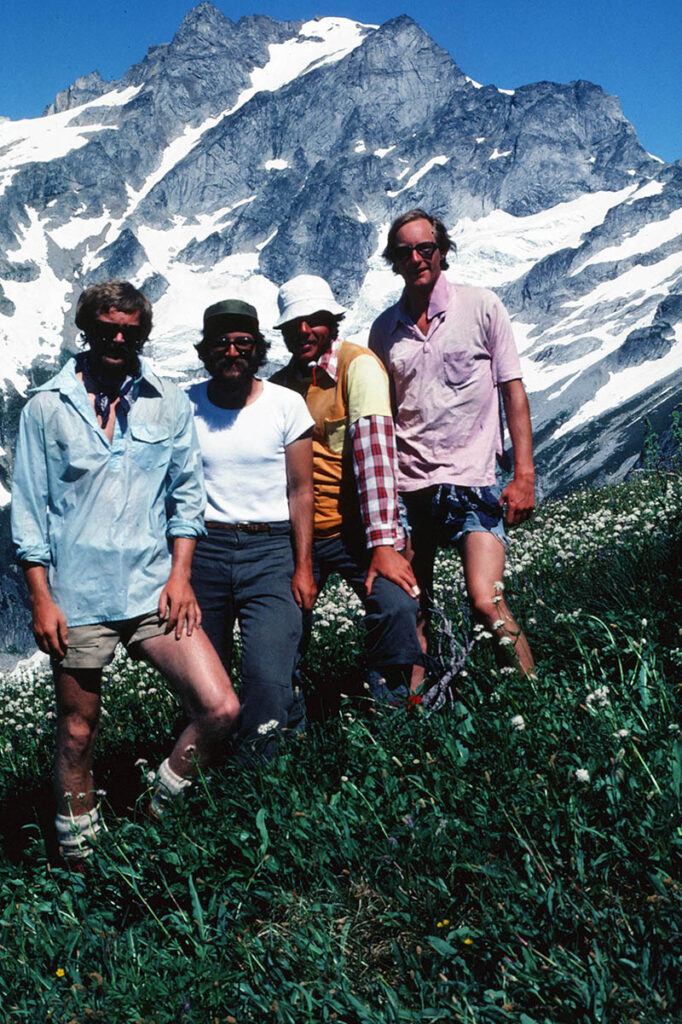
If Ashenbrener and Gathe were more a spectacle than the broads doing Broadway on the rim, it was the accidental result of their testosterone-fueled ambition and “Grapes of Wrath laden journey,” as he refers to it. Clanking with a flea-market load of equipment, they slogged their way to the rim while questioning their life choices. Now, they had the added pressure of getting back in time to see the evening news. The crampons and the ice axes were used in a final push, but the rope stayed in the pack.
Upon cresting the rim, the gravity of the mountain’s history struck Ashenbrener, who recalls it looked like a “mountain with the top completely sliced off with a machete.” Along the newly formed rim were dozens of climbers peering into the crater, stepping too far out onto frozen ledges and cornices. Other climbers yelled warnings at them while Ashenbrener worried for their safety. Hundreds of feet beneath them, the crater steamed. A new lava dome had already risen out of the crater’s floor. Beyond them, where her belly had split open and poured forth, nature had been decimated.
When Mount St. Helens erupted, 24,000 megatons of thermal energy were released, 7,000 of which occurred in the initial blast. (In a morbid comparison, this is the explosive equivalent of approximately 1,600 WWII atomic bombs.) Entire swaths of forest were flattened, thousands of acres of trees left like charred toothpicks fanning away from the mountain. The rivers of lava, snow, and mud (known as lahars) carried millions of tons of debris down the Toutle and Cowlitz rivers, wiping out bridges, lumber camps, and homes along the way. Thousands of large animals were killed, entire species of small and large mammals as well as amphibians, extirpated.
By the time Ashenbrener made it to the rim seven years after the eruption, only patches of fireweed had begun a brave return. Stretching miles before him still lay the carnage of a landscape turned shades of gray-brown. He was struck by a sense of geological fascination and wonder, by the power within the Earth to make a whole mountain disappear.
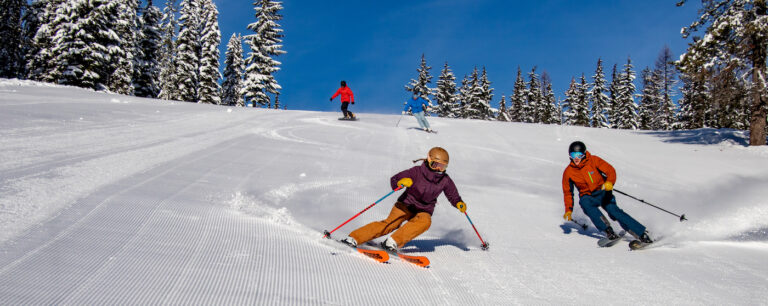
Not wanting to miss the evening news, the men rearranged their boots into their overloaded packs and donned their skis. “Forever, I will remember the sound of clicking into our bindings and pushing off,” Ashenbrener said. “We seemingly sailed off the top, over the heads of the climbers.” It was validation of the day’s gear-slog. In turn after turn, they descended 5,000 feet of snow, from one kind of crunchy ice to softer grains until they reached their Nordic skis, quads aflame with the burden of their descent. It’s one thing to ski down a volcano; it’s another thing to do it with a pack full of 1980s climbing gear.
The two raced back toward civilization in search of a bar with a TV on and a phone to call their families and tell them to watch the news. But that night, Jennings was busy reporting about presidential candidate Gary Hart’s tryst with Donna Rice and the men were bumped from national evening news by a woman after all.
“We are fortunate here in the PNW,” says Ashenbrener with charming optimism. “We don’t have cyclones, typhoons, hurricanes, flash floods. We just have the Big Burn of 1910 and the volcano of 1980.” Would Ashenbrener climb the iconic route again? “No,” he said, “I don’t do things twice.” Perhaps that is because some things can only be done once.
Ammi Midstokke lives in North Idaho, where the hills don’t explode. This season, she’ll be traveling to the Peloponnese to climb another less volatile mound of rock.