The 21-year-old has gone from a workplace accident to the paraclimbing world championships in short order.
By JP Vallières
Cover photo courtesy of Angus Meredith
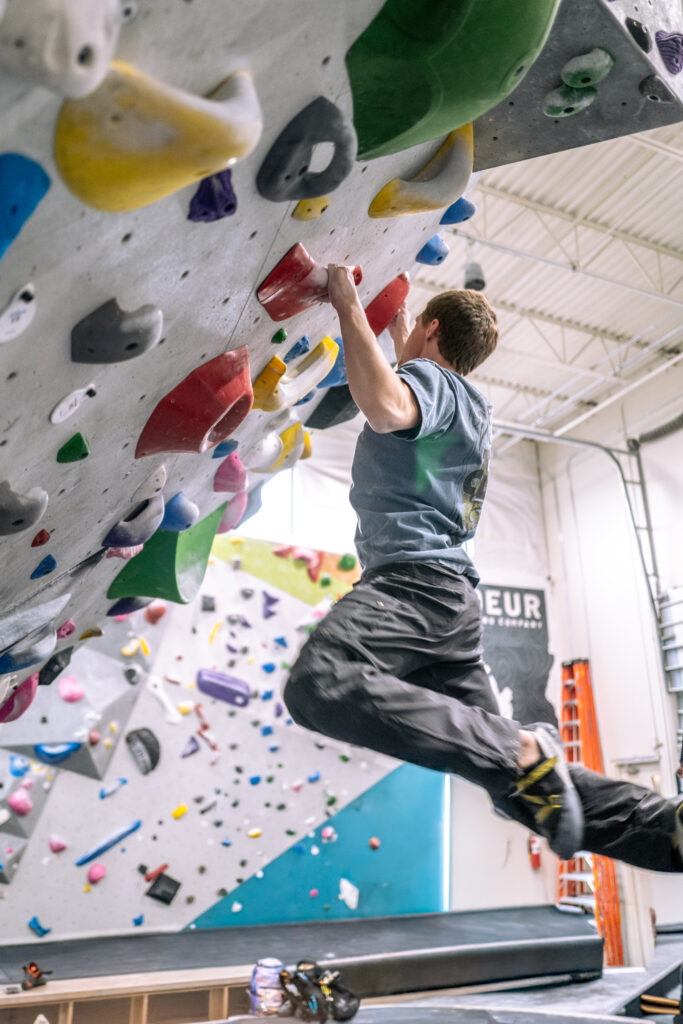
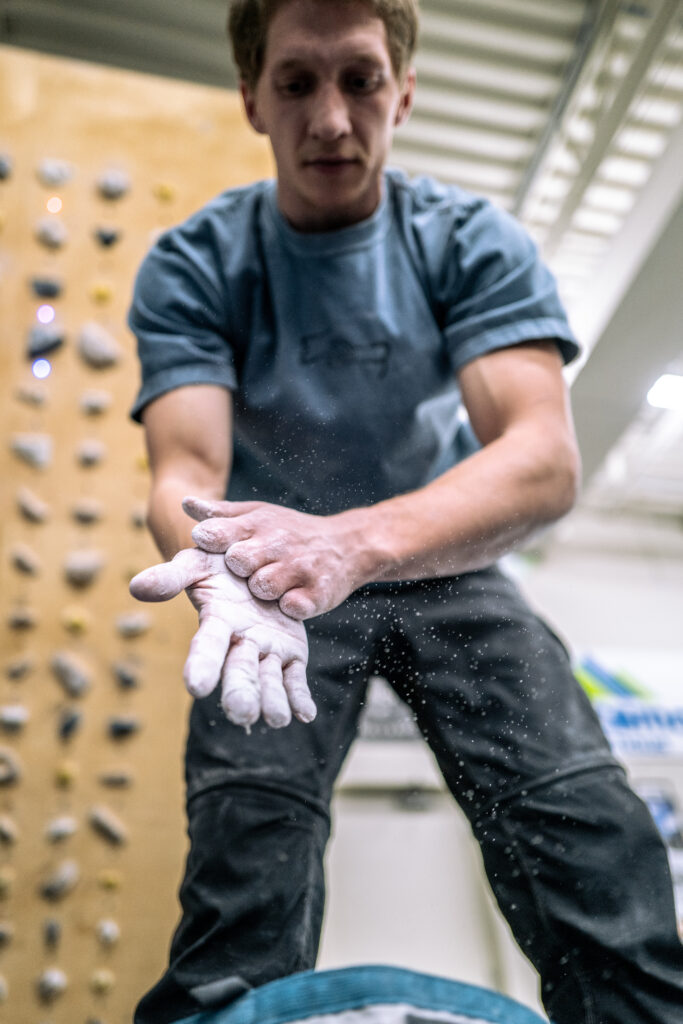
Mason Keough is strong. One of the strongest climbers you’ll find at any climbing gym in the area. His style is efficient, clean and powerful, depending on what’s needed. He’s one of those climbers who makes others a little jealous, whispering to themselves, “Why can’t I do that?” But there’s one major difference between Mason Keough and most climbers you’ll find at the gym or crag. Mason has no fingers on his left hand.
I’ve seen many things, but never in my life have I seen anyone like Mason Keough. When I watch him climb, I search for the Jedi force aiding his vertical progress, something that might appease my rational beliefs about what the human body can do. But Mason doesn’t seem to think all that much of himself. “When I approach a hard climb, I trick myself into thinking it’s possible. Someone’s done it. I’ll do it too,” he says. And then he does.
After finishing high school in Coeur d’Alene, Mason got a job with a company that drills water wells. He liked the consistent work and the people he worked with. While drilling, he was asked to stand near rows of heavy pipes. It was part of the routine, something he’d done hundreds of times before. But this time, a pipe popped out of the clip, which sent a cascade of heavy metal onto his left hand. Mason’s coworkers drove him an hour to the hospital while he kept his hand on ice in a cooler. “I wanted to die,” says Mason. “The pain was more than anything I thought possible.”
This is when Mason showed me pictures—close-ups—of the aftermath. He warned me, but I was not prepared for what I beheld. Think of the “Saw” movie franchise, but worse, because this was a real-life horror scene. The damage was irreversible, launching him into a life no one could plan for.
With the support of his wife and family, Mason prioritized his rehabilitation. It began with something called desensitization therapy, where a physical therapist gently places your severed hand into a cushy bowl of beans. But the beans feel like shards of glass, sending jolts of pain through your arm. Once you can handle beans, you move on to cold cooked pasta, then dry pasta. And so on, until everyday materials aren’t a threat to your nerve endings.
While gaining strength and courage, Mason’s big brother, Payton, introduced him to paraclimbing, a competitive sport for climbers with physical disabilities. After some research, Mason discovered he qualified for the AU3 paraclimbing division. AU3 represents upper arm amputation in the third category. Then he researched how hard he needed to climb to win at the national level. “I figured out that if I could climb 12a/b, then I’d have a chance,” says Mason. I asked him if he’d ever climbed that hard before. He said, “No. Never.”
Sure enough, only six months after the accident, Mason climbed harder than he ever had before. How is that possible? It’s not, for most of us, but Mason Keough is a guy who doesn’t let anything stand in his way. “So many people make themselves disabled by placing limits on themselves,” says Mason. “If you say you can’t do it, you’ll never have the chance.”
After winning the 2025 nationals in Oakland, Mason hopped on a plane and flew around the world to compete on the World Cup circuit, where he met the defending champ, Mor Sapir of Israel, and the other finalists from around the globe. “I knew them. They didn’t know me,” says Mason. The athletes were sectioned off in a room for five hours while waiting their turn to climb. “It was awkward,” says Mason. “I just went around with my chessboard, asking people if they wanted to play.”
Chess is Mason’s only other hobby. He’s one of those guys who can plan multiple moves ahead with concentrated intensity, which can be super distracting to his opponent (that’s the best excuse I can come up with for losing). He loves chess and asked me what my online ranking was. I told him I haven’t played online in decades. He just shrugged. That’s the thing with Mason. He doesn’t see the point in doing anything halfway. He took gold on the World Cup stage in France at age 21, just two years after his injury and only seven months after his first paraclimbing competition.
In 2026, Mason is training to compete on the world stage again. Since he’s the most recent World Cup winner, everyone knows him. He’s the man to beat. But it’s not feasible for most of us to take time off from work to fly to Austria, France, Korea and Japan. So he’s hoping to raise enough money to cover the expenses—not just to go and win, but to be a source of inspiration for those who’ve suffered debilitating traumas. (Venmo: @keoughmason)
Mason Keough will likely deal with nerve pain for the rest of his life. Even now, if his left hand connects just right with a climbing hold, a searing agony surges through him. It takes 10 minutes or more for the pain to subside before he can stand and face the wall once more. Then, after a deep breath, he repeats this mantra to himself: “Perform, perform. Execute, execute.” And without any more thought, he grabs the first hold and makes his way to the top, all over again.
JP Vallières is the author of the novel “The Ketchup Factory: A Love Story.” You can find him climbing at Q’emiln Park in Post Falls.