By Ammi Midstokke
Cover photo courtesy of Ammi Midstokke
I recently picked up Henry David Thoreau’s classic naturalist philosophy book, “Walden.” I suspect that most outdoors folks, knowing the transcendentalism of Thoreau is basically a rite of passage for any serious claimant of nature loving or minimalism, at least pretend to have read it.
I wasn’t sure if I had, which is to say I probably had read enough meaningful quotes to pass. If I had read it, the meat of the matter had altogether escaped me, whether by my youthful inexperience at the time or a lapse in memory. Or perhaps Thoreau’s heady use of now-antiquated English lost me in the first paragraphs, much like the time I tried to read “The Federalist Papers.” (It was an ambitious response to the days of Covid, when Hamilton became the soundtrack of my life.)
The summary of “Walden” is that contentment and meaning can be found in the mere act of survival. Thoreau was righteous in his arguments for such a life, considering volitional poverty a kind of freedom, but it was his deep connection to nature and his surroundings that brought him joy. For the two years he spent on the shores of Walden Pond, he wallowed in the simple pleasures of a well-made jacket, tending to his bean crop and the lost art of contemplation.
Perhaps that is what’s wrong with the world: We aren’t spending enough time observing it or thinking about it. Which is decidedly different from consuming it through our usual means of bludgeoning by roadside advertisement, curated media feeds, and all the ways in which society screams our inadequacies at us with a relentless cacophony of not-enough.
Which brings me to ask: Does anything bring us deeper satisfaction, connection or understanding than stepping out of that fabricated world and into the natural world? If we know this in our bones, why don’t we do more of it? What beliefs do we have that justify our collective suffering and destruction of the planet?
Realizing this after a morning of busyness that mostly achieved nothing beyond a painful awareness of my vapid existence, I went outside to find my dinner and commune with nature.
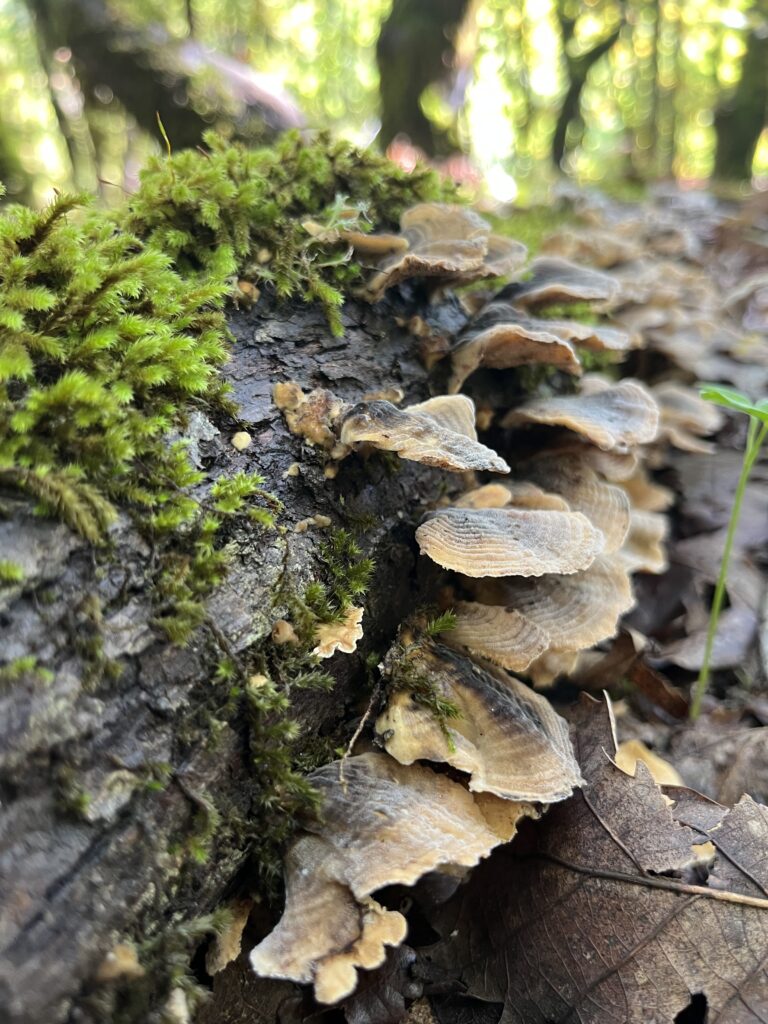
I spent the afternoon picking my way through the undergrowth in search of mushrooms. I found them, along with gratitude for the abundance of wilderness, and hundreds of new and independent thoughts that had been lurking just behind all the “productivity” of my morning. I discovered edible mushrooms growing along animal tracks, then discovered the paths of the forest creatures and their favorite places: fields of ferns and sun-kissed slopes, shaded ravines lush with moss, stony clutches turned by the curious snouts of boar. I felt a kindredness to them, a bittersweet reminder that we, too, are of nature. Only, too often, too far removed.
Back home, the mushrooms were cleaned and baked in oil with herbs from the garden. They tasted of the complexities of the forest: millennia of soil and weather, the metallic tang of mineral, something earthy and rich and buttery. And as I put another log on the fire and watched it twist and dance, as if to call heat up from the Earth’s core in some ancient ceremony, I knew Thoreau was right. All we really need is food and shelter. The rest is superfluous at best.
Ammi Midstokke lives mostly in North Idaho, where there are in fact no wild boars. Sometimes, she retreats to a stone cottage in the mountains of Greece to live off the land and practice contemplative knitting.