A hesitant swimmer dives into open water for a cause bigger than herself.
By Ammi Midstokke
Cover photo courtesy of Ammi Midstokke
One hundred thousand years ago, humans embarked on their first known and intentional swims, diving into the Mediterranean Sea in search of clams and marine meals. While they witnessed many forms of mammalian life instinctually paddling through the water, humans did not demonstrate this ability. Nor are our bodies, though buoyant, particularly well-suited to swimming: We’re designed for upright positioning, lack gills, and cannot hear or see well when submerged.
With the exception of the Sama-Babau, who have developed spleens 50% larger than the average human and have the capacity to hold their breath for over 10 minutes, as well as dive over 200 feet deep, we are not a species of biological swimming advantage or efficiency. Water is a threat to the human body: salt water can fill our lungs with foam and suffocate us, cold water can cause lethal hypothermia quickly, and then there’s the part about us needing oxygen to breathe.
Because of this, and that one time I got a rash at Salvation Army summer camp from all the urine in the water, I have never been a swimmer. I refuse to celebrate the hype of cold plunging or ice baths. I do not triathlon. And I sure as hell don’t swim for fun.
Sometimes, I fall off my paddleboard and am forced to tread water. Occasionally, I have been known to risk my life in the frigid waters of Patagonia in journalistic endeavors while chasing racers.
Which makes it all the more baffling that I would commit myself to an open water swim the length of Lake Pend Oreille in July. Ideas like this are hatched on summer patios with canned cocktails in hand, and a friend who is getting even for the death-defying mountain traverse you just dragged them over. That friend, Lindsey might be her name, is also probably a former competitive swimmer. The kind that would accidentally place 4th if you dropped her in the CDA Crossing open water swim.
“We should relay the lake next summer,” she said, like it was an afternoon splash.
“Yeah,” I said, dumbly. It was later I learned the swim is approximately 33 miles.
The sport of open water swimming has ancient roots, with events being recorded in Japan in 36 B.C. Roman soldiers were said to have trained in open water swimming (and used this skill to attack foes who did not think they’d cross rivers). Centuries later, Lord Byron swam the Dardanelles—the Turkish strait between Europe and Asia. It is said that the currents forced the one-mile distance into a four-mile swim. His efforts paid off: The poem he wrote about it propelled him to literary fame.
Since the first Olympic games in 1896, when Athens held all the competition swims in open water, there has been a formal renaissance in the sport. Swimmers have been crossing straights and setting records all over the world, with women often outperforming men in ultra distances. While men still dominate the racing scene, studies are increasingly showing that non-competitive open water swimming is dominated by women.
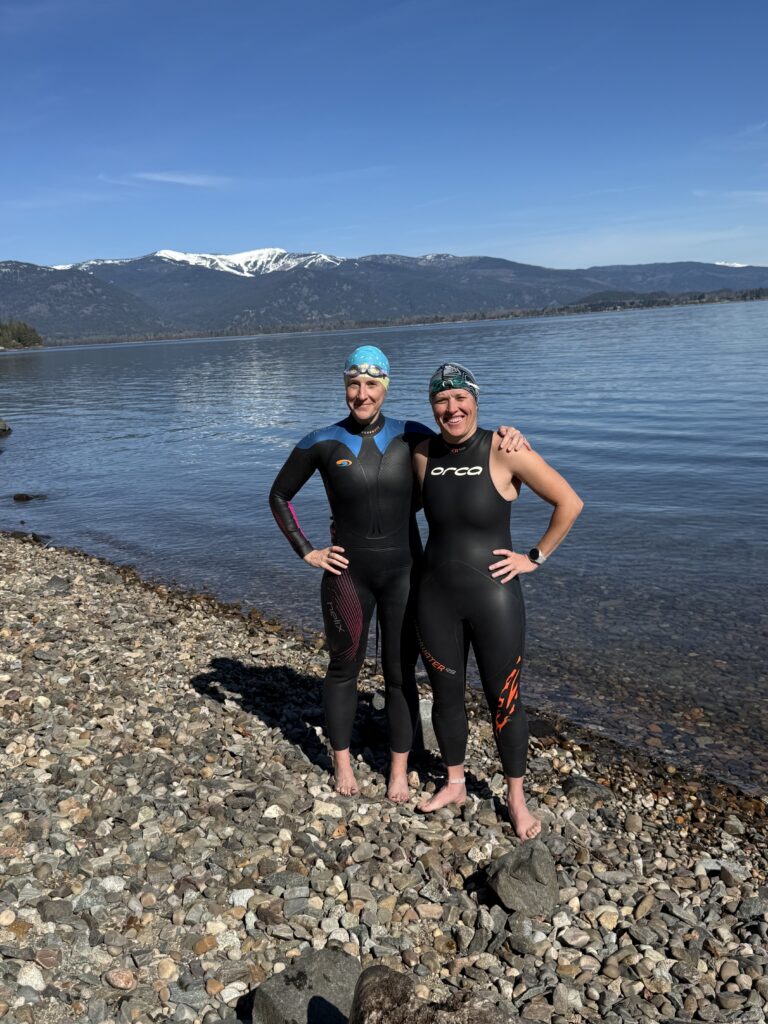
Our two-woman team doesn’t plan on dominating anything (except maybe our snacks). But our swim is about representation: We’re swimming from the south end of the lake to Sandpoint City Beach to kick off the Sandpoint Pride Festival. We’re calling it The Paddle to Pride.
The festival is a program of the Sandpoint Alliance for Equality (SAFE), a nonprofit dedicated to increasing equality and cultivating inclusion for the LGBTQ+ community throughout Idaho. Last winter, they partnered with Schweitzer Mountain Resort to bring the first ever Pride on the Mountain event to life as part of SAFE’s expanding Pride Outside effort, which includes group mountain bike rides, walks and hikes.
Because the LGBTQ+ community has been under increasing attack from legislation in recent years, impacting a cultural shift toward more hostility, SAFE has been expanding its efforts to engage Idahoans in dialogues of acceptance and common ground. For many, that common ground is the great outdoors we share and celebrate. This context is important, because I would never be talked into doing something this cold, wet and stupid, unless it was for a worthy cause.
The first thing I needed to do was learn how to swim. I thought I knew how to swim, because I haven’t drowned yet, but then I went to the pool with Lindsey, who effortlessly swam twice as fast as me. It would be to my benefit to stay slow: in two-hour intervals, that likely leaves my teammate swimming more than 20 of the miles. Serves her right, if you ask me.
I spent three months flailing about in the local YMCA pool, being out-lapped by the group of retirement home field-trippers still wearing cotton swimsuits from 1932. They were very encouraging, though confused about how I can have so much muscle and still move so damn slow. Discouraged and concerned about the amount of chlorine I was inhaling, I sought out advice on how to learn swimming. Several people mentioned a book called “Total Immersion: The Revolutionary Way to Swim Better, Faster, and Easier” by Terry Laughlin. That last part sounded perfect.
I ordered my book and dove into the chapters that told me over and over again that this way of swimming was going to change my life. All I had to do was trust the process. I studied the drawings. I watched the YouTube videos. I went to the pool and did the drills. Then I tried to swim again, only to discover I was even worse.
Proprioception, the nonvisual internal sense that tells the brain where body parts are, has never been my forté. I am a writer—I spend my life imagining things the way I want them to be. In my mind, my running form is sleek and easy. In videos, I look like Quasimodo on a Fireball bender. In the pool, I think I’m Ariel and can sing underwater. From the poolside, the lifeguards are white-knuckling their shift the moment I start splashing my way down a lane. I’m like a toddler in a puddle with new rain boots, only, on my hands.
If I was to succeed in anything more than scaring fish, I would need more formal coaching. This led me to an organization in Seattle called NinjaSwim, which sounded like the antithesis of my current method. Who doesn’t want to swim like a ninja? I tried to sound natural when I mentioned working toward an open water swim event this summer, despite a deep loathing of cold water. They were thrilled for me—open water swimming is their specialty. Then they asked about my experience and the distance of the swim. They graciously disguised their concern and suggested we get started a year ago, or today, if that’s when my schedule was open.
If you’ve ever jumped into an alpine lake or dipped in a river, you’ll know that it is a kind of baptism every time. It is a purification of the most natural means: fresh air, clean water, natural surroundings. The act itself is invigorating. Add nudity to the whole ritual, and it’s also liberating, a visceral reminder that we and nature are the same thing. We are from water, of water and shall return to it when our bones have shed our bodies. But it is not just an accidental ecologically spiritual experience—it’s also good for us.
Proponents of open water swimming, sometimes called “wild swimming,” or just swimming for the less pedantic of us, tout the many benefits of the sport, because it most often pairs with cold water. Cold water exposure is known to increase white blood cells (the immune system’s army) and improve metabolism. It reduces inflammation and soreness. Studies show that the increased circulation to the core and head increases blood circulation to the brain, supporting cognitive function and memory.
If we combine that with our knowledge of the positive mind and body impacts of exercise and exposure to nature, one can see why the sport is growing in popularity. Skirt the edge of a PNW body of water on any given morning, summer or winter, and you’re bound to find a few bobbing heads laughing cheerily, as if 32-degree submersion is fun and not traumatizing at all.
All you need to start your own journey are a few safety measures: a visibility buoy, some goggles, a wetsuit when appropriate and some water that is clear of traffic. Then, you merely have to muster the courage for a systemic shock that’s likely counter-intuitive, ignore the fact that you’re designed for land and put one hand in front of the other. I hear there’s something like nirvana out there. Just swim toward it.
Ammi Midstokke lives in North Idaho, where she mostly avoids water. This summer, she’ll be getting more familiar with Lake Pend Oreille and her aquatic ancestors.