By Ammi Midstokke
It’s easy for us to pick sides and rest on the laurels of our conviction. And if that doesn’t make us feel good enough about ourselves, we can join the ranks of the one-uppers: vegans who don’t eat honey, homeschool parents who teach their kids Latin, and misanthropic conservationists.
Mitch Friedman was some kind or another of that in his youth, following the then-popular trend of monkeywrenching and civil disobedience as guerrilla conservation tactics, and generally rousing rabble toward industries that were perceived threats to nature, particularly to old-growth forests. He’s got an arrest rap sheet that reads like a Greatest Hits list.
I’m glad we have these people—those who chain themselves to trees, live in them, sit on the roads and try with all their gentle might to slow the seemingly inevitable destruction of our planet. Only it doesn’t seem to be working as a singular tactic.
That shared observation is what I found refreshing in Friedman’s new book “Conservation Confidential: A Wild Path to More Effective Activism.” Friedman takes a long, hard look at conservation efforts past and stares into the necessities for the future.
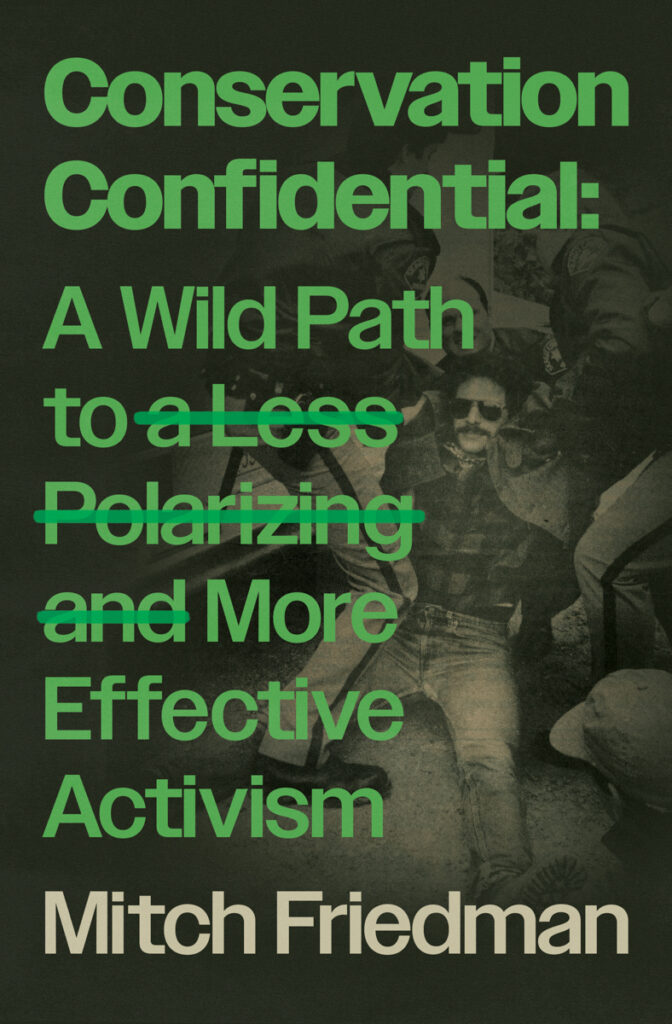
After pissing off enough police to reconsider his methods, Friedman became one of the West’s most effective conservationists through what was then the unlikely and underused approach of collaboration. This requires other lost forms of art, such as empathy and listening, to gain perspective. When it comes to land management and the preservation of wildlife habitat in the face of progress, our only option is to make room for each other.
As Friedman discusses in his book, balancing the needs of ranch owners with the habits of roaming wolves requires deep listening and problem solving, and sometimes the culling of a wolf. When we exist in a space of all-or-nothing, we cannot come to a solution, only blame. Allowing wolves to roam and cattle to range means the occasional lost cattle or lost wolf. So how do we collaborate to minimize both and live in some realm of … let’s not call it harmony … but sustainability? (I hear someone in the back whispering, “tofu.”)
It’s not just the wolves. It’s who uses our trails and how they are used. I’m a fan of seeing an e-bike make nature more accessible to a recently-replaced knee. Are they appropriate everywhere? If we want private landowners to place land in conservation, how do we uphold their personal values and needs to support that? If we want logging to stop mowing down old-growth and essential ecology, where should our timber mills source the wood products we all use? If we want to keep driving our cars at highway speeds around the clock, how do we protect animals (and drivers) from the harm of collision—not to mention interruption to essential wildlife travel paths?
The breakneck pace of development in the western world has come with a blind sense of abundance that has scarred landscapes and dramatically reduced native wildlife populations. We can do better, are obliged to do better, but we cannot do it by taking sides. Rather, we must do it by listening to all sides. And this must include the voices of the trees, the rivers, the flora and fauna of our precious planet.
Ammi Midstokke has allocated her garden as a spider-habitat and established a spider corridor from her kitchen to the outdoors. Some spiders even make it there alive.