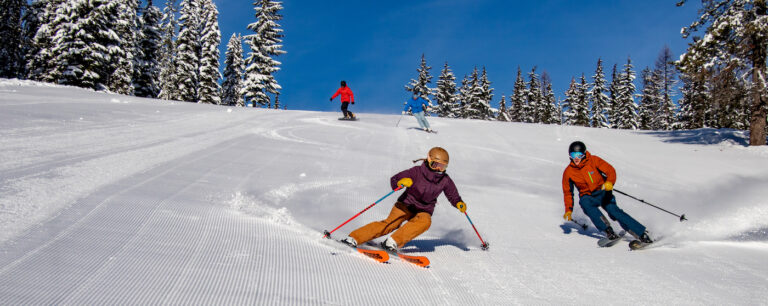
By the time YouTube was born, Sandpoint-based “Ski Flakes” had been broadcasting its steep, deep, and irreverent take on mountain life to the Inland Northwest for more than a decade.
By Barry Campbell
Cover photo courtesy of Terry Cooper
As the saying goes, it pays to be in the right place at the right time. And sometimes the pay isn’t in the form of income, but life experiences. Terry Cooper, founder of the regional ski-cult hit “Ski Flakes” videos, can tell you all about that.
Cooper grew up in South Carolina and, like so many others, took a long and winding path to Sandpoint, Idaho. After serving in the Navy during the final years of the Vietnam War—including the evacuation of the country in 1975—he set out on a restless quest for meaning. He crisscrossed the country on a motorcycle, pedaled thousands of miles by bike, and ultimately found his way into the Rocky Mountains.
By the early 1980s, he and his wife, Brenda, had moved to Sandpoint after a stint in Steamboat Springs, Colo. For Cooper, who had fallen in love with skiing in the low-lying resorts of North Carolina before discovering Colorado’s big mountains, Schweitzer offered a new kind of home, and he was hooked when he saw it. “What I wanted to do was ski,” he said. “That was it.”
A Big Camera and a Bigger Idea
Skiing was Cooper’s passion, but making a living in Sandpoint required creativity. He bought fixer-upper houses, tended bar, taught ski lessons, and eventually became a realtor. Still, his eyes were on the slopes. The question was, how could he ski as much as possible and share the stoke with others?
The seed for “Ski Flakes” was planted in Steamboat when Cooper saw a man shooting ski footage on the mountain and screening it at the bar that night. Patrons loved seeing themselves on screen.
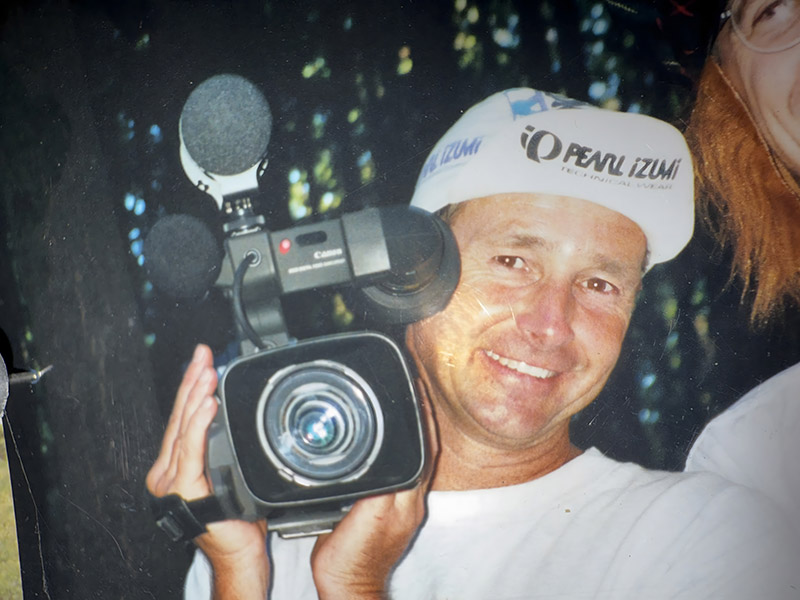
By 1992 he brought that idea to Schweitzer. Inspired, he invested in one of the earliest pro video camcorders. With a little hustle, he arranged to play his ski footage at a local après-ski bar, The Keg (now the St. Bernard), for $30 a week. People started asking for copies.
Soon, Cooper was selling VHS tapes, experimenting with editing and eyeing local cable TV airtime. He pitched the idea to Schweitzer’s then-owner, Bobbie Huguenin, who saw the potential to connect the mountain with the town. “Ski Flakes” was born.
From the start, even though it was partially inspired by the gold standard ski filmmaker Warren Miller, it was clear this was a local/regional production. It was raw, spontaneous, and real. “It was reality TV before reality TV,” Cooper said. “You went out, shot whatever was happening and made a story out of it.”
Will Work for Free Skiing
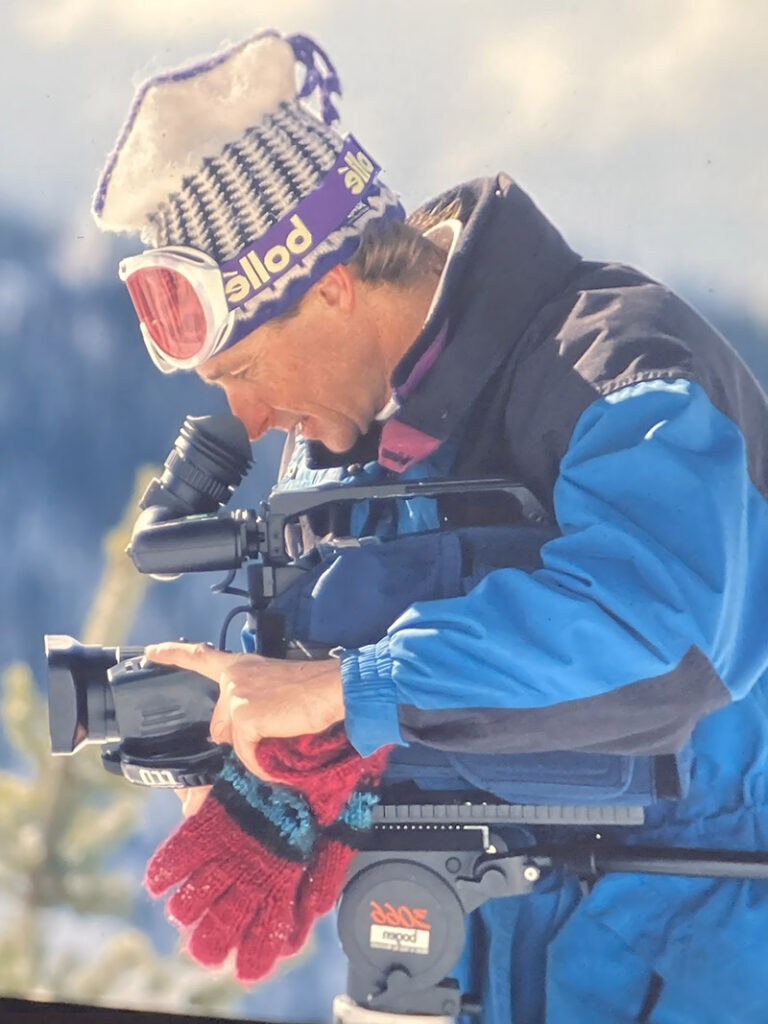
Cooper rarely scripted “Ski Flakes.” He didn’t have to. Armed with an attention-grabbing camera, a crew of local characters and an eye for quirky moments, he turned the slopes, bars and parking lots into his stage.
In the early years, his crew included journalists and storytellers like Liz Zimmerman and Chris Park, who helped craft narratives from Cooper’s footage. In later years, Scott Rulander joined as a second videographer. Their payment? Ski passes bartered through Schweitzer. “We were poor, but we were skiing,” Cooper laughed. Together, they cranked out 60-minute episodes every week during ski season—13 in a row—each a mashup of ski footage, party scenes, interviews and local history.
Editing was a marathon. Cooper remembers staying up all night on Wednesdays to deliver a finished VHS tape to the cable station Thursday morning. He’d drive tapes to Sandpoint, Coeur d’Alene, Spokane and even ship them to Cranbrook for broadcast. The show aired nearly constantly in Sandpoint and on Schweitzer and on prime time in the other markets, reaching an estimated audience of 100,000 viewers. In the pre-internet 1990s that kind of reach was unheard of for a regional ski program, and it caught the attention of advertisers.
Powder, Parties, and Pioneers
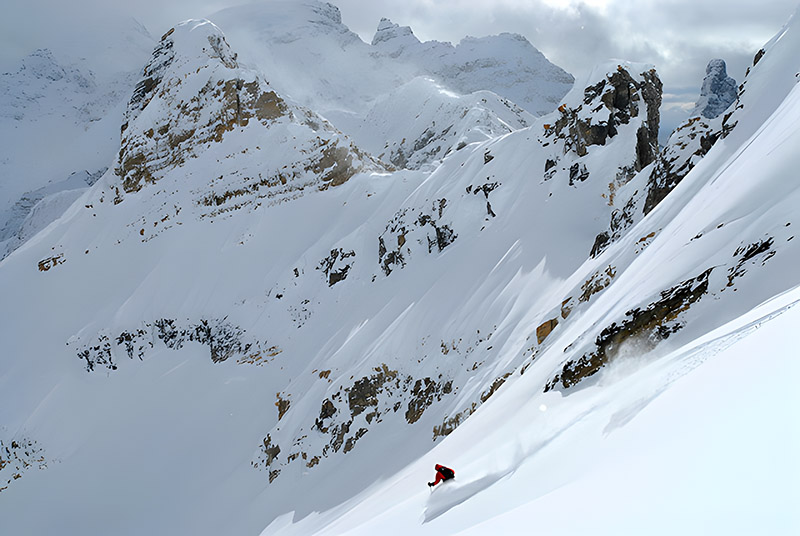
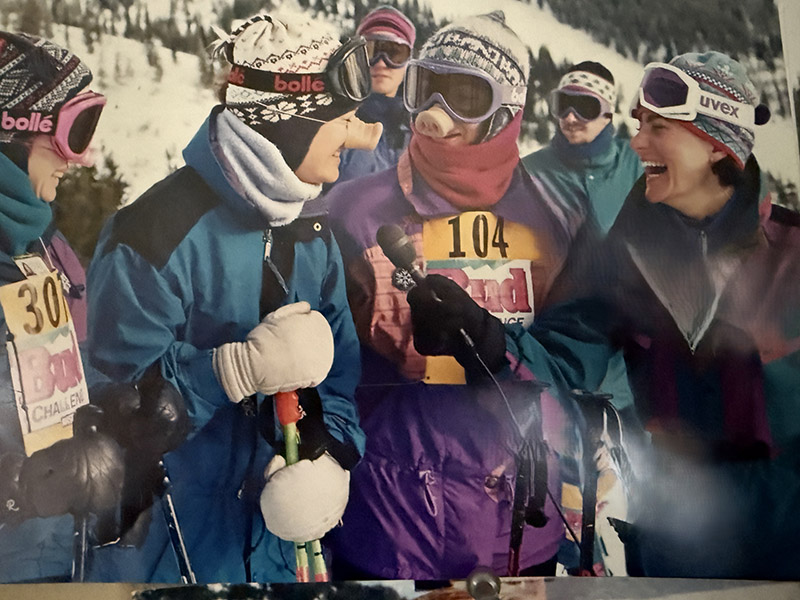
What made “Ski Flakes” unique was its mix of content. Half the show might be deep powder turns and tree skiing, the other half might be raucous bar parties or tongue-in-cheek interviews. “I didn’t want it to be sexist, but I did want it to be sexy,” Cooper recalled. “People wanted to see themselves having fun, and they wanted to see the characters of the mountain.”
But Cooper also had a historian’s eye. He sought out Schweitzer’s early pioneers—Jim Toomey, Bud Moon and Jack Fowler—and wove their stories into the show. He tracked down home movies from Schweitzer’s earliest days in the 1960s and preserved them on television. He spent years interviewing Red Mountain legend Booty Griffiths, who helped found one of the oldest ski schools in North America.
For Cooper, it was never just about turns. It was about people and place. “My goal was never to tell their story,” he said. “It was to have them tell their story.” Over nearly two decades, “Ski Flakes” became a cultural record: Olympians Nancy Greene and Susie Luby; the Mahre brothers; TV personality Ben Stein; extreme skier Glen Plake; and countless locals found themselves immortalized on tape.
Though Schweitzer was home, “Ski Flakes” expanded into what Cooper dubbed the Borderline Tour, a circuit of ski areas along the U.S.-Canada border: Red Mountain, Whitewater, Fernie, Kimberley, Panorama and Montana’s Big Mountain (now Whitefish Mountain Resort). Years before it was branded the “Powder Highway,” Cooper and crew were skiing it, cameras rolling.
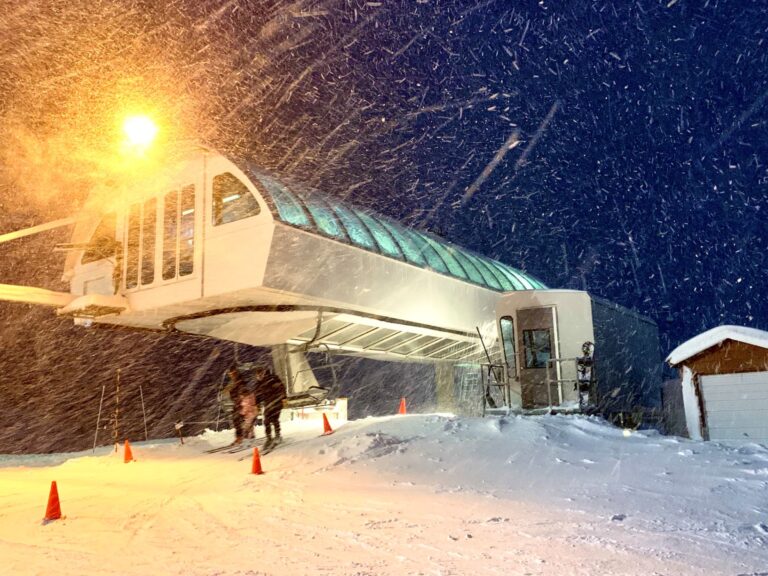
They didn’t have the luxury of waiting for perfect conditions like big-budget film crews. If it was storming, they shot. If visibility was bad, they turned it into a skit. That improvisational style gave the show an authenticity and relatability that connected with viewers.
For a self-described ski bum, “Ski Flakes” opened doors that money couldn’t buy (like tours of the secret-est of stashes). Cooper and his friends were invited heli-skiing, cat-skiing and into backcountry bowls. “I’d say, ‘I need to ski first so I can shoot you coming down,’” he laughed. “So I always got first tracks.”
He filmed scary moments too: huge sluffs flowing over his skis, sketchy helicopter drop-offs and fogbound adventures. But for every adrenaline spike, there was an equally memorable dinner with a ski legend like Mike Wiegele or a behind-the-scenes story with resort pioneers.
“It was the American Express camera,” Cooper said. “Carte blanche. You showed up with a big camera and people let you in.” Filming “Ski Flakes” also opened a door for him to travel the world with wealthy clients as their personal videographer, including luxe African safaris, Ferrari shows and Bing Crosby’s Los Angeles estate.
If all this sounds glamorous, the reality was grittier. Cooper had invested tens of thousands of dollars in cameras, editing decks and music rights at a time when he was making only a fraction of that. Editing was primitive and tedious. He sold ads himself in each market—Sandpoint, Spokane, Coeur d’Alene and Cranbrook—often giving small businesses more airtime than they paid for just to help them succeed.
Financially, “Ski Flakes” survived, but just barely. What sustained the show, though, was passion, barter and Cooper’s other career in real estate. “I talked to every single business in town, trying to get them to buy an ad on my show. And everybody’s like, ‘Television, what are you talking about? I don’t even own a TV. What the @%$# is that?’ It was pretty funny.”
“I never made a lot of money,” he admitted. “But I got to do things I never would have in my life otherwise.”
Rex Cosgrove, who has skied at Schweitzer for decades dating back to the mid 70s, recalled that limited channels were available in Sandpoint, and as soon as they arrived in town from their home in Moscow, his kids would turn “Ski Flakes” on—and leave it on—for the weekend. “It was kind of a big deal at the time that you could watch this local skiing culture on TV. And we loved it,” he said.
Shelf Life
By 2010 new filming for “Ski Flakes” wound down. Digital editing and internet video were reshaping the media landscape, and the economics of selling ads for a regional ski show no longer worked. But reruns kept it alive—up until 2025, it was still on Sandpoint’s local access cable—and even today, episodes still loop in Pucci’s Pub at Schweitzer.
Pucci’s owner, Eric Salontai, said that the TV tuned to “Ski Flakes” often gets more viewers than even events like Gonzaga hoops games. “People still will look back toward the Ski Flakes TV. Even we employees still watch because we’re riders and enjoy the mountain scenes,” he said.
He added that airing footage of Schweitzer’s history, including icons like patrollers Arlene and Ted Cook, and the namesake of his pub, John Pucci, in their prime, complements the pub’s atmosphere. “Ski Flakes just made you feel that you were part of this thing. You’d see familiar faces, and you’d see how much Terry loved the scene he was shooting. And that’s the real telltale of the good that he was doing, because he was super eloquent in his filming. Not derogatory, not vulgar, none of that,” he said.
These days Cooper doesn’t sit still long, ripping tele-ski and single-track mountain bike lines nearly every day. However, the “Ski Flakes” Worldwide Headquarters (his office) is jam packed with a mountain of epic footage: 7,000 hours of video, only a fraction of which ever aired. He has slowly begun digitizing it, with thoughts of future documentaries or online archives. He also has extensive footage of rock star interviews at the Festival at Sandpoint and other rarities. “It’s history,” he said. “And it has value. You can’t get those stories back once they’re gone.”
Legacy of a Flake
In retrospect, “Ski Flakes” was far more than entertainment. It was connective tissue, linking Sandpoint to Schweitzer, Idaho to British Columbia, locals to Olympians. It captured a culture in transition: the rise of snowboarding, the shift from straight 210s to shaped skis, the evolution of après-ski from wild bar parties to today’s typically toned-down and phone-absorbed scenes. Most of all, it preserved the personalities—everyday skiers and mountain characters—who made the Northwest ski scene what it was.
Today, as GoPros and drones flood social media with instant edits, Cooper’s work reminds us of a different era: one where telling the story took commitment, community and countless late nights with VHS decks and turntables. “Ski Flakes” may not have made Cooper rich, but it gave him—and the Inland Northwest—something even better: a lasting story of the evolution of a sport and a region.
This winter Barry Campbell plans to chase powder at Schweitzer, soak up some Baja sun and continue building his company, Two Oaks Marketing.