By Alana Livingston
Cover photo courtesy of Alana Livingston
Riverside State Park’s new all-terrain wheelchair pilot program marks an important step toward expanding trail access for people who use mobility devices. By offering an Action Trackchair on select trails, the park is testing what it looks like to move access beyond pavement and into the landscape itself. For Ellie, who lives with complex mobility, sensory, and vision challenges, the opportunity matters—even when the experience isn’t perfect. She looks forward to going out, but once on the chair, the uneven terrain can feel overwhelming. “The trail feels bumpy and uneven,” she said, explaining that smooth pavement feels more comfortable and predictable for her body. That distinction is exactly why pilot programs like this are so valuable.
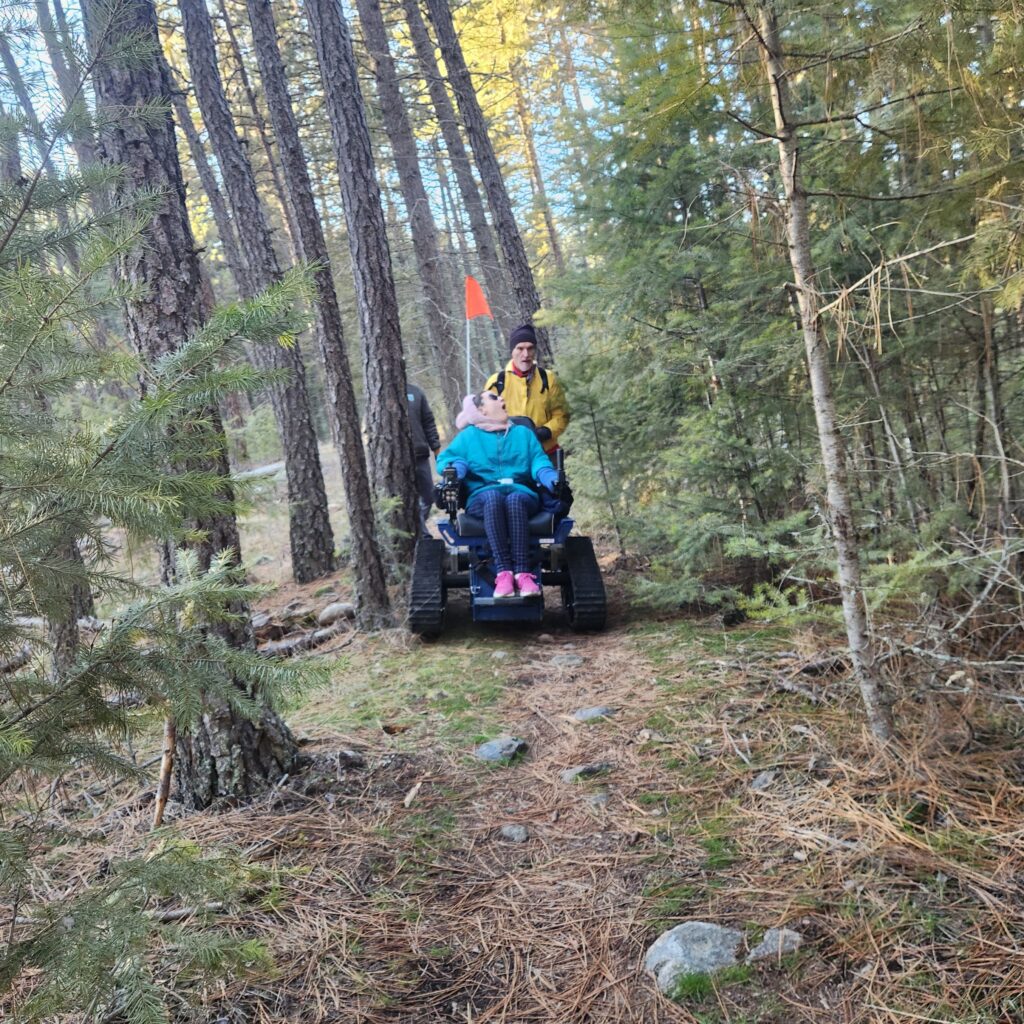
The Action Trackchair can handle challenging terrain and opens up real possibilities for some users. As Ellie’s father, Rolf, points out, its strength is also its limitation. The chair is powerful and rugged, which may suit people with physical mobility limitations well, but can be less comfortable for those with sensory, balance, or vision challenges. “Every individual’s needs are different,” he said, emphasizing that access works best when people have options rather than a single solution. This pilot offers a chance to learn—not just about equipment, but about the full experience of access. That includes practical considerations like parking, loading space, restrooms, and trail design, as well as less visible factors such as comfort, confidence, and anxiety.
Programs like this help shift accessibility from an afterthought to a planning principle. Starting with one tool creates space to ask better questions, gather real feedback, and design future programs with adaptability built in from the beginning. The Action Trackchair gets the conversation moving. What comes next will determine how far access truly goes—and how well our public spaces support healthier, more connected communities where more people can belong.