By Jean Arthur
Cover photo courtesy of Jean Arthur
Sunrise promises a sparkling midsummer morning at 6,644 feet elevation at the summit of Going-to-the-Sun Road at Logan Pass. A dozen vehicles snug into parking spots on an August morning as hikers lace boots for early starts on Glacier National Park’s famous Highline Trail. My family plans to hike another popular trail from the parking lot at Logan Pass, the Hidden Lake Trail to Hidden Lake Overlook, a 2.7-mile climb among wildflowers, mountain goats, bighorn sheep, ermine and the occasional grizzly bear.
We know from experience that the parking lot—all 236 spots—fills by 8 a.m. on July and August mornings. Until about 7 p.m., drivers will troll the parking lot to find a spot, testing patience and pleasantries. Occasionally arguments break out and rangers must intervene.
The bustle begs the question: Are we loving our national parks to death? Between resource depletion, crushing roadway overuse, damaging pollution, and resource defilement due to garbage, trampling and theft, park lovers are demanding changes.
Rangers and park staff can barely keep pace. Since the beginning of 2025, permanent park staff positions decreased by 24% for all parks according to the nonprofit National Parks Conservation Association. In Grand Teton National Park, the Trump administration’s budget cuts eliminated 16 of the park’s 17 supervisory positions.
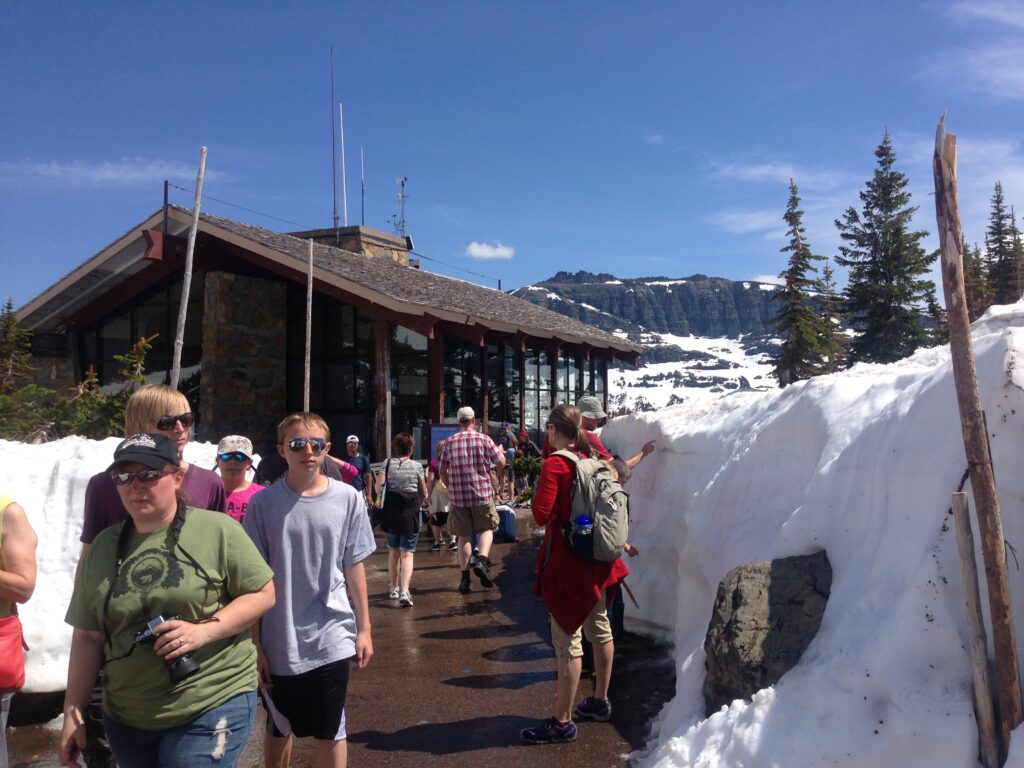
Glacier, which is America’s 10th national park and spans 1.2 million acres in northwest Montana, has experienced explosive visitor numbers in the past decade, as have other public lands, challenging the resources, park staff and visitor restraint.
I have frequented Glacier National Park for five decades. My group and I hit the park early to try to beat the new summer crowds. Tailgate coffee, locally grown fruit and prebaked muffins entice our sleepy crew out of warm vehicles to our truck where my husband cranks up the camp stove and makes a couple of bistro’s worth of coffee. To my family, this morning is reminiscent of two decades ago when there was available parking, room to hike without crowding and lots of wildlife.
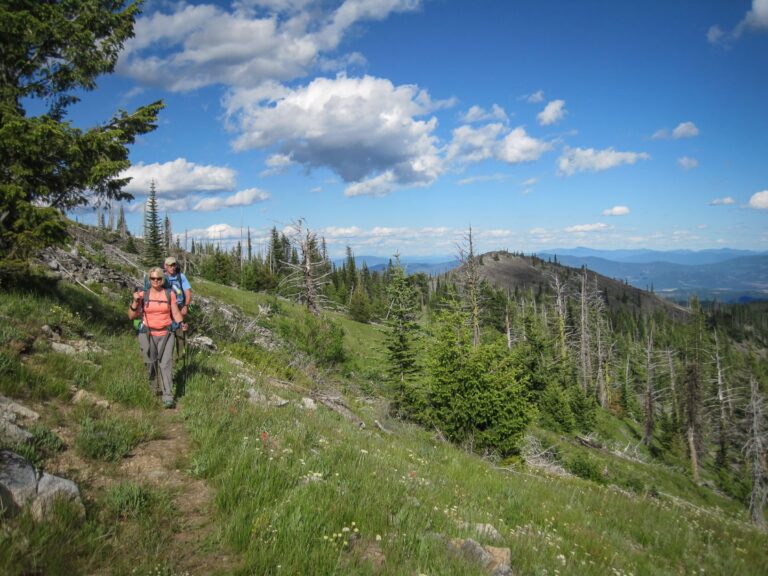
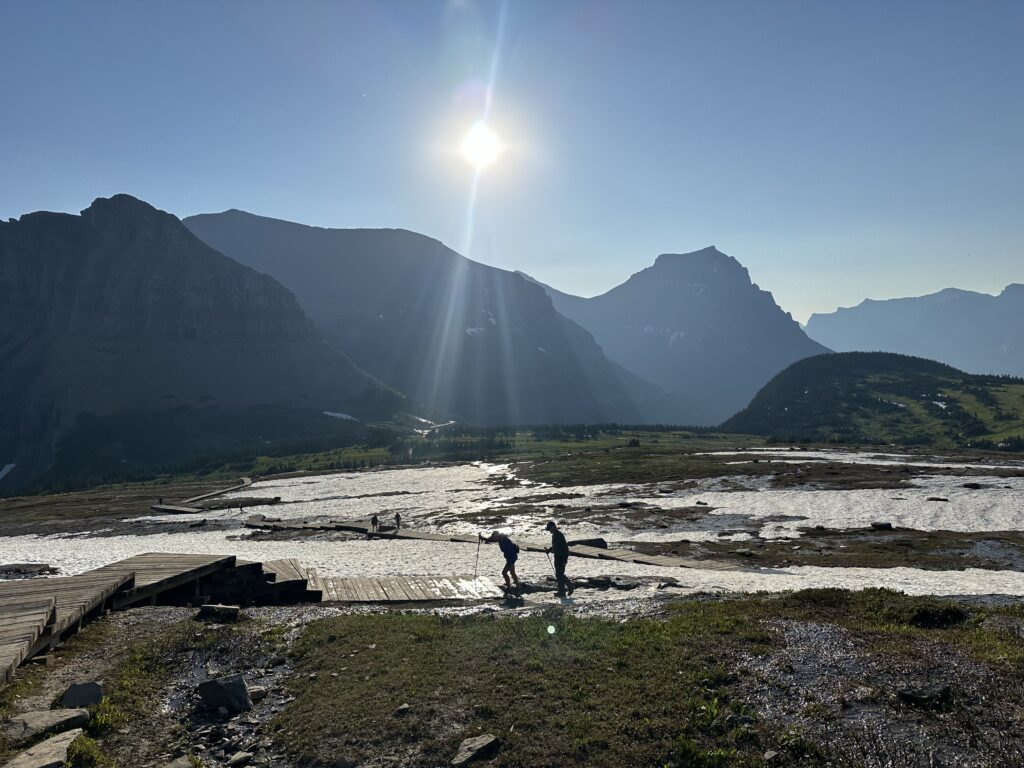
We lock up leftovers and head up the paved trail that climbs to a boardwalk, then dirt, and then a snow-covered route with just a few other humans. Brilliant pink heather hugs the ground. The higher we climb, the more glacier lilies—yellow sprites of the high country—shiver in the breeze. A sizable herd of bighorn sheep skitter across rocks then settle for naps with their lambs.
With so few boots on turf this morning, it’s hard to imagine the significant increase in visitation that Glacier has endured. In 2024, more than 3.2 million people entered Glacier, its third-highest visitation year ever and an increase of 300,000 visitors from 2023.
Glacier’s 40 percent increase in visitation from 2012 to 2024 is not an anomaly. According to Zion National Park Superintendent, Jeff Bradybaugh, in a letter to Congress, “There are 423 park units in the National Park System encompassing over 85 million acres across our nation, but visitation trends among the individual parks greatly vary. In 2020, overall visitation dropped to a 40-year low due to the impacts of the COVID-19 pandemic.” And then spiked.
In his statement titled, “Lessons from the Field: Overcrowding in National Parks,” Bradybaugh notes that a third of the national parks saw record visitation during the pandemic as people sought outdoor spaces. In 2021, visitation across all NPS units reached 297 million recreation visits, a year when Utah’s Zion National Park alone saw 5 million visitors for the first time in its history and double the number from 2010. Some mitigation efforts are working. Several parks now use timed entry and ticket systems, including Glacier, which piloted vehicle reservation systems for summer months. Because my crew and I visit Glacier often, we know to use Recreation.gov to purchase a park pass and a Going-to-the-Sun Road ticket.
On our glorious August morning, the road remained quiet at predawn; we only encountered a pair of motorcyclists who cruised the Sun Road to Logan Pass. But by the time we hiked up to the Hidden Lake Overlook, snapped a few photos and walked back, the parking lot was full and the trail overworked.
“Pack your patience and plan ahead,” reads Glacier National Park’s webpage, “Tips for Dealing with Crowds.” We’ve also packed out other people’s candy wrappers, broken sunglasses and bad attitudes—a visitor aggressively urged us to rush so they could have our parking spot. We left feeling squeezed and a bit Grinchy about sharing our favorite park.
For national park gateway communities, the tourism boils down to dollars. According to economists at the University of Montana in Missoula, annual nonresident spending in the state totaled $5.82 billion, a two-year average for annual spending. The Institute for Tourism and Recreation Research found that the region surrounding Glacier saw $2 billion in revenue, while the region surrounding Yellowstone averaged $1.3 billion. Yellowstone’s borders also include Idaho and Wyoming. The two Montana regions collectively saw 57% of nonresident travel spending.
Oregon park visitor Barbara Nelson and her husband encountered long waits when they entered the park’s west gate at West Glacier this summer, even though they had booked tickets for the road and activities in advance. This was not their first park visit, and they’ve witnessed growing wait times at entrance stations, parking lots, trail heads and concession restaurants.
“We got stopped in the hot sun and felt crowded,” Nelson recalls. “That morning, we started about 9 or 10 a.m. from West Glacier. A busy, August day. Getting behind those red buses is annoying. We got stopped at [the] top of [the] pass and there was still snow. So we had a snowball fight as we were waiting in traffic.”
The Red Busses offer interpretive tours on Going-to-the-Sun Road. Free shuttles between Apgar near the west entrance and St. Mary at the east entrance alleviate some vehicle traffic, but hour-long standstills still occur, and not always where snowball fights can ensue. There are just many people who want the Glacier experience—including my crew. The park is on pace for another record-breaking summer as of early August 2025, with early counts showing a sizeable increase of more than 12 percent over 2024.
Overtourism is defined as the phenomenon whereby certain places of interest are visited by excessive numbers of tourists, causing undesirable effects for the places visited. The global nonprofit Responsible Tourism offers a platform for change, helping travelers and communities take responsibility for making tourism more sustainable.
Locals grasp at reasons for overtourism: short-term rentals alluring and available which push out long-term renters, post-pandemic need for healthy outdoor travel, alluring Instagram images sans mega throbs of tourists, and the Yellowstone Effect, in which people watch Kevin Costner’s television drama “Yellowstone” and visit Montana, Wyoming and Idaho believing a fictional tale of the American West—and wanting a piece of it.
The “Yellowstone Effect” brought 2.1 million visitors to Montana in 2021, according to the University of Montana’s Bureau of Business and Economic Research. Fans spent $730 million, yet caused some locals to channel Beth Dutton and mean-mug away visitors—it didn’t work.
The Tourons of Yellowstone Instagram page, dedicated to documenting bad behavior and egregious offenses, stir up locals’ ire too. The Tourons videos often involve humans (and sometimes their pets) getting too close to wildlife in parks or illegally traipsing near Yellowstone’s extremely hot and fragile hot spring features—and sometimes not surviving.
Thoughtless visitors trample delicate flora, leave trash and feces, and cause congestion and environmental degradation also felt in housing and infrastructure. Instagrammers sometimes position themselves in precariously dangerous spots for the glory, monetizing the public places. My family witnessed a woman who waded through a swift stream below a waterfall for her ego-driven photo taken by an accomplice. Other visitors, who had to wait 20 minutes for an Instagrammer-free view, did not wish her well.
The organization Responsible Tourism writes on their website that tourism has breached a tipping point: Hosts and guests are often dissatisfied. “The challenge is to make all destinations sustainable and to avoid spreading the problem. For local government and protected area managers, the key question is: Will the destination use tourism or be used by it?”
Gateway communities are trying to help visitors find their inner angels. In Jackson, Wyoming, the tourism board adopted a “selfie control” campaign after many tourists got too close to wildlife. Jackson’s “Take care of what takes your breath away” includes signage, advertising and smiling reminders from locals. Bozeman, Montana’s “Becoming Outside Kind” campaign encourages trail etiquette by educating new and longtime residents about how to behave outside. Whitefish, Montana created the “Be a Friend of The Fish” campaign to promote visitor stewardship.
As Responsible Tourism notes, a global backlash to overtourism and bad behavior has resulted in violence. Protestors in Barcelona, Spain attacked tourists with water guns and called for visitor-accommodation restrictions. Protests against mass tourism and gentrification in Mexico City turned violent, damaging storefronts. Venice banned cruise ships from the city center and instituted a tourist tax. Some cities and attractions now limit the number of visitors, such as Bruges, Belgium, which capped the number of cruise ship arrivals and instead encouraged daytrippers. Solutions remain elusive.
Summer 2025 saw particularly challenging crowding in Glacier, in part because the much-loved Many Glacier Valley, with its lodge, lakes, campgrounds and trails, underwent extensive utilities reconstruction. Limited parking forced limited access.
The reward for patience, however, includes spectacular views, cool evenings with remarkable sunsets, and incomparable trails. My crew will wait to camp and hike during the slower season, late September, to avoid the crowds and try to be good stewards of our favorite park.
Jean Arthur hikes and bikes and boats on public lands and waterways with family, friends and dogs. This fall, she’s picking huckleberries after the early frost sweetens up the hucks and the hues of the backcountry.