By Justin Short
Cover photo courtesy of Justin Short
I was in a friend’s garage in Kalispell last winter when I noticed a bunch of eye-catching punk show posters on the wall. At least I thought that’s what they were. These posters advertised the seven previous editions of the Joe Cosley Pancake Ride (JCPR), a bike event that falls into a category that Midwest gravel cycling community builder and author Amanda McMahon (“Butt Stuff” and “Sh*t I Wish People Had Told Me When I Started Endurance Racing”) has dubbed a “you’ve-gotta-know-a-guy” event, meaning someone actually has to tell you about it. She said in a recent social media post, “There are races out here that don’t have marketing teams, influencers, or clean branding . . . and they’re better because of it.”
JCPR is usually set in or around Whitefish, Mont., in the neighborhood of 200-plus miles with start times that may seem absurd to anyone not acquainted with Spokane’s Midnight Century. “Oh,” I thought, “I’m definitely going to that.” I did. An ambitious young dude from Bozeman told me just before the 4 a.m. start, “I’m going for 12 hours . . . or at least I’m going to try to beat the sunset.” Considering the 17,000 feet of climbing that awaited us, I thought I’d be lucky to beat the second sunrise. I didn’t.
JCPR’s namesake is a colorful character from a hundred years ago: Joe Cosley was a Glacier National Park ranger who was arrested several times for poaching, a writer and teller of tall tales who was known to snowshoe as much as 70 miles one way to attend a barn dance, thus conjuring up an image that evokes an extra grassy and rootsy appeal for this event that holds the “spirit of gravel” in a death grip.
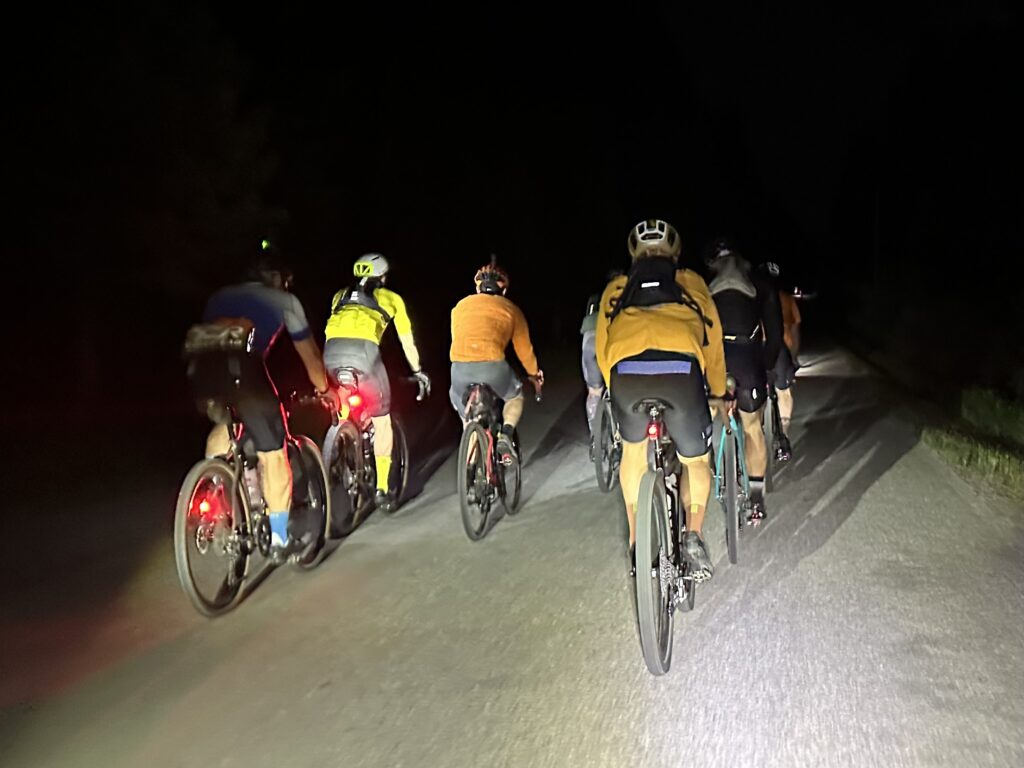
The much talked about spirit of gravel harkens back to the early 2000s to the loosely organized Midwest “gravel grinders.” Riders were looking for a fun way to prepare for solo 24-hour mountain bike races. Gravel races themselves weren’t the goal, so riders and event organizers were free to goof off and have fun, creating an infectious adventure-party atmosphere. That’s how gravel exploded. It was not, as some suggest, an industry plot to sell us more stuff. It was innovation pushed upon the industry by the riders, though the bike industry has definitely taken the gravel label to absurd lengths. But we understand, businesses need to milk as much profit from gravel as possible until we all decide that hoisting bikes up stairs is the next big thing (see EDC column from previous issue of Out There).
It’s hard to imagine a cycling population massive enough to create what it created, but a middling sized gravel race in the Midwest will draw around 800 riders. By the mid-2010s, a few influential World Tour pro cyclists retired and joined the gravel scene. Soon, scads of pros were jumping ship from the pro ranks to continue their careers as gravel privateers; money, sponsors and corporate interests were soon to follow.
“Oh great, here comes the money to ruin everything,” cried the doomsday prophets. And while some things have changed—for example, some of the bigger gravel races have been bought out by large corporations, namely Life Time Inc. (formally Life Time Fitness)—it’s fair to say that “big gravel” is what legitimized gravel racing as a sport, bringing sponsors, media attention and a professional class of riders who are in it to win it. Gone are the days when someone you’ve never heard of can win one of the big races. But it’s only a small minority of riders on the front end of these races who are actually racing. The rest of us are there for the personal challenge with ourselves, for the adventure, or, most importantly, to goof off and have fun with our friends.
For the most part, the big events have maintained, and even amplified, the festival atmosphere that made them popular, it’s just more expensive now. Entry fees are getting into the $2.50/mile range for a hundred-mile race, not to mention hotels, Airbnbs, campgrounds and everything are booked solid a year out, and event registration is down to a lottery system at many of the big races. Still, I think it’s totally worth it to travel to these bucket list events. The closest thing we have to “big gravel” in the whole PNW and Inland Northwest is the Belgian Waffle Ride in Bozeman and The Last Best Ride (TLBR) in Whitefish.
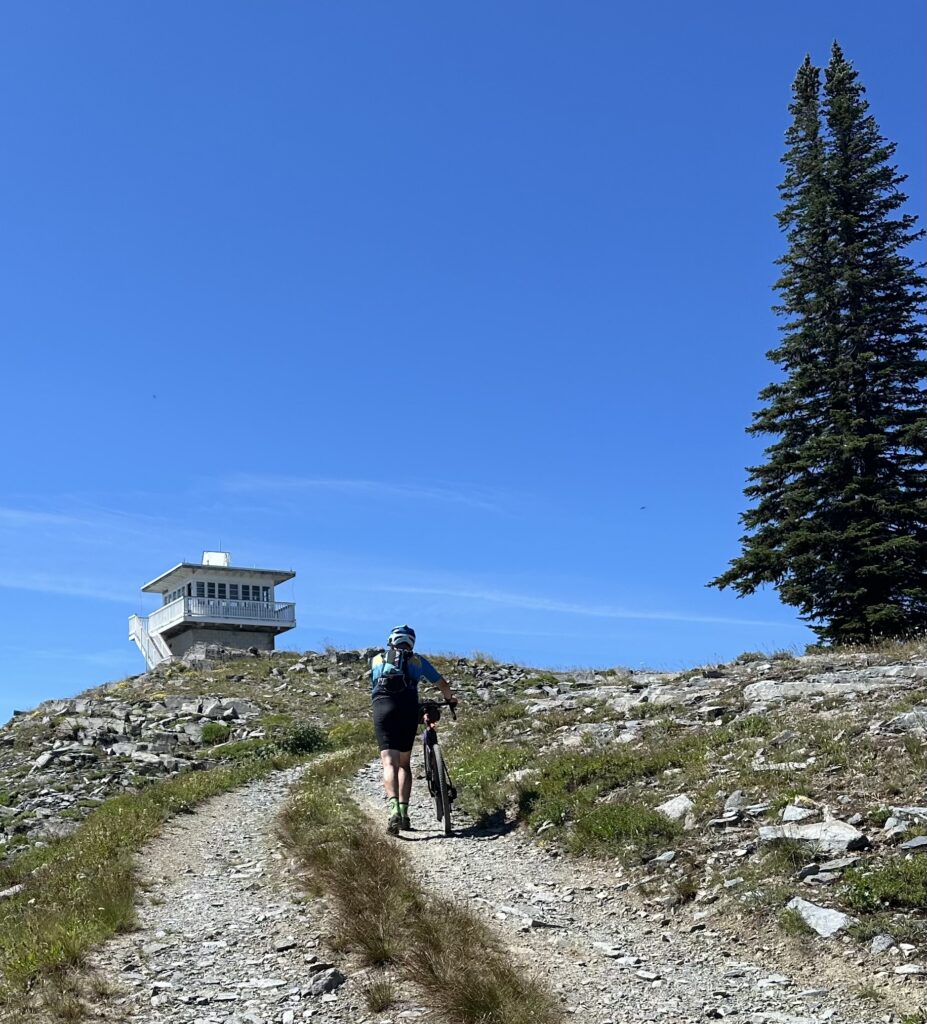
Timing is of the essence for a small-scale grassroots event to share space with one of the big guns of the gravel racing world. For years, the “middle management” of the JCPR had a verbal agreement with TLBR to keep them at least a month apart, and better if it’s a couple months. But TLBR was sold to a person from out of town, and was suddenly moved to the same month as the Pancake Ride. Some might suspect foul play, big business squeezing out the little guy, but more
likely it’s all about permitting issues. It’s hard to get permits to run a huge event like TLBR, which the Pancake Ride skirts entirely.
Fortunately, small grassroots operations are nimble enough to meet changing circumstances. The JCPR crew is minimal, and participants are warned in the waiver they must sign and not expect support on the course for things like routing, food and water, or protection from wildlife. Unless you are self sufficient, you will definitely get lost, you might starve, and there’s a chance you’ll get accidentally bear sprayed in the face by middle management himself.
For 2026, the Pancake Ride is shoe-horned into the same weekend as Last Best, and riders are encouraged—at least by the Pancake Ride organizer—to do both. That is how “ Lead-Boat” emerged, from the combination of Leadville Trail 100 and Steamboat Gravel, which are also on the same weekend in Colorado . . . except that both races are Big Gravel events and owned by Life Time Inc. Hopefully middle management doesn’t receive a cease-and-desist letter for suggesting something cool.
The Pancake Ride has cut its distance to 100 miles for 2026, running a mind-blowing route right out of downtown Whitefish. The entry fee will still be a measly $4 Powerball ticket purchased at a gas station on course. That’s where I’m going to spend my money this July 25, but I will definitely stick around to yuck it up with all my friends from Spokane and elsewhere who signed up for Last Best.
OTO writer Justin Short is not a ranger, nor does he poach Riverside State Park very often, but he definitely tells tall tales and would totally ride a fat bike 70 miles one way to attend a barn dance.